

When a tornado warning drops, workers have seconds to reach cover. The NSSA storm shelter they're running toward either meets a recognized performance standard or it doesn't. Not every structure marketed as a "storm shelter" delivers the same level of protection, and that gap matters when lives are on the line.
Understanding what NSSA certification requires, and what it doesn't cover, helps safety directors and operations managers make smarter procurement decisions.
What NSSA Storm Shelter Certification Actually Requires
The National Storm Shelter Association sets performance criteria that align closely with FEMA 361, FEMA 320, and ICC 500. A shelter certified to NSSA standards must meet specific requirements around:
- Structural integrity under wind loads consistent with EF5 tornado conditions
- Impact resistance tested against high-velocity debris
- Occupant capacity based on actual floor space, not manufacturer estimates
- Ventilation adequate for the rated occupancy during an extended shelter-in-place event
- Emergency egress that functions even under post-storm debris conditions
These are not soft guidelines. They require engineering review and third-party verification. A shelter carrying NSSA certification has been evaluated against criteria that a general-purpose storage container or prefabricated room simply has not. That distinction matters more than many buyers realize, especially when the structure they're considering gets called a tornado shed rather than a certified storm shelter.
Why NSSA Storm Shelter Standards Matter More in Industrial Environments
A residential homeowner choosing a storm shelter faces a relatively simple decision. Industrial and commercial operators, however, face a different problem entirely.
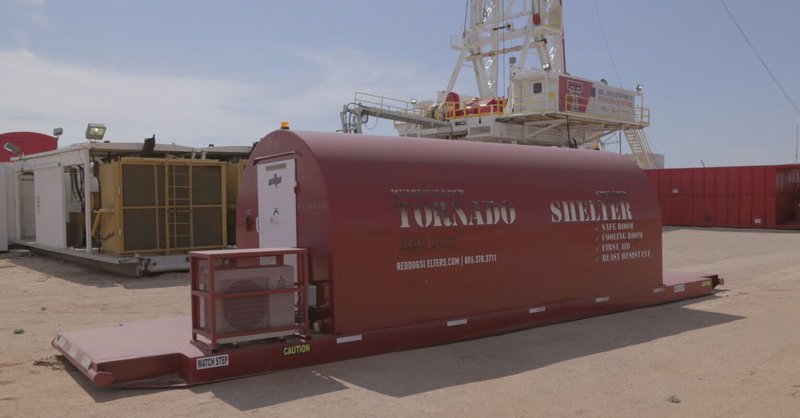
On a construction site, an oil field lease, or a remote utility project, the stakes include:
- Dozens of workers at a single location
- Sites that are exposed, remote, or hard to reach quickly
- Regulatory scrutiny from OSHA and state safety agencies
- Liability exposure if an incident occurs and shelter adequacy is questioned
- Insurance requirements that increasingly reference recognized shelter standards
In these environments, a shelter without verified NSSA or equivalent certification creates compounding risk. If a storm event results in injuries and the shelter in use lacked certification, the legal and regulatory consequences can be severe. Certification creates a documented, defensible record that the selection was based on verified performance, not marketing claims. It also carries real weight when it comes to the impact tornado storm shelters have on insurance premiums, a factor that risk officers and facility managers increasingly factor into shelter decisions.
What NSSA Certification Doesn't Tell You
NSSA storm shelter certification addresses structural performance. However, it does not answer every operational question that matters on a working job site.
Certification standards generally do not evaluate:
- How quickly a shelter deploys on a new site
- Whether the shelter needs a concrete foundation or mechanical anchoring
- How easily the unit repositions as a project evolves
- Whether the shelter is accessible to workers spread across a large site
- How the unit performs logistically on rocky terrain, remote locations, or sites with limited equipment
These factors determine whether a certified NSSA storm shelter actually protects workers in real conditions. A shelter with strong paper credentials that takes weeks to install, requires excavation, or can't move when the work zone shifts may be less effective in practice than a unit that deploys in under 10 minutes and repositions as the project requires. For sites with rocky or uneven ground, above-ground storm shelters solve terrain problems that underground options simply cannot.
The Full Picture: NSSA Storm Shelter Certification Plus Operational Performance
The right standard is NSSA certification as the floor, combined with operational characteristics that make protection practical under real job site conditions.
When evaluating shelters for industrial use, ask these questions:
- Does a third-party engineer individually certify and stamp each unit?
- Does it meet FEMA 361, FEMA 320, and ICC 500 alongside NSSA?
- How long does setup actually take on an unprepared surface?
- Does installation require concrete work, anchoring hardware, or heavy equipment?
- Can the shelter relocate without a specialized contractor?
- Can additional units be added as headcount grows?
These questions separate a shelter that meets the standard from one that meets the standard and works for how industrial projects actually run.
How Red Dog Shelters Meets the NSSA Storm Shelter Standard and Goes Further
Red Dog Shelters designs above-ground tornado shelters built to FEMA 361, FEMA 320, ICC 500, and NSSA standards. Third-party engineers individually certify and stamp every unit, so the certification ties to the specific shelter, not just a product line.

Beyond the certification baseline, Red Dog shelters address the operational realities that site safety teams face every day:
- No foundation or mechanical anchoring required. The patented aerodynamic anchoring system uses a pressure differential created by wind to generate a downward force, securing the unit without excavation or hardware. Workers can place a unit on dirt, gravel, or asphalt, and it secures as soon as it touches down.
- Deployment in under 10 minutes. Fast placement matters when a project timeline leaves no room for weeks of site prep.
- Repositionable as projects evolve. Customers can move units themselves if they have the means, or Red Dog repositions with a winch truck. This flexibility matters on large sites where work zones shift frequently.
- Scalable capacity. As headcount grows, teams can add units. As a project winds down, they can reduce the fleet.
The Big Dog unit accommodates 32 or more personnel and includes dual HVAC, 128 dB sirens, strobe lighting, and optional power connectivity. The Tow Dog handles up to 12 personnel and tows behind a standard pickup for maximum mobility.
The NSSA Storm Shelter Standard Exists for a Good Reason
NSSA certification reflects real engineering requirements developed in response to real storm events. It exists because "tornado-rated" is not a self-defined category, and because shelter failure carries irreversible consequences.
For safety directors and operations managers making shelter decisions, the NSSA storm shelter standard is the right starting point. The follow-up question is whether the certified shelter actually performs in the conditions your site presents.
Contact Red Dog Shelters to discuss your site layout, workforce size, and project timeline. The team can help you match the right units to your protection requirements and determine whether a lease or purchase fits your project best.