
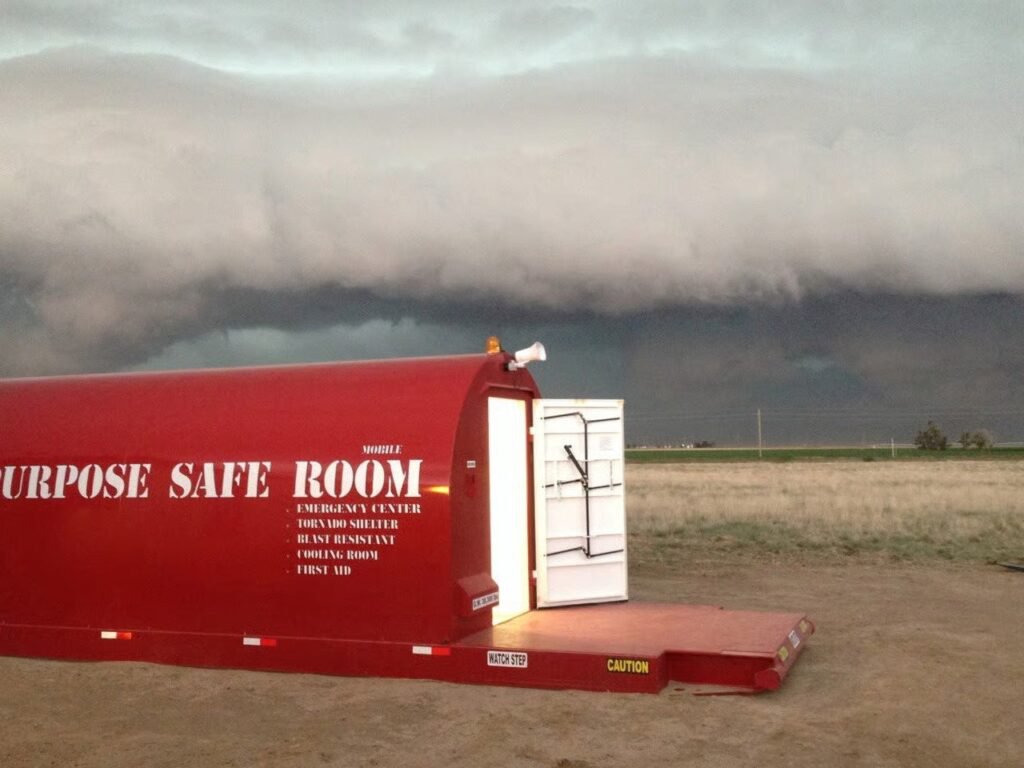
On remote industrial sites, wind shelters are not a backup option. They are the primary line of defense when a severe storm hits. Wind speed alone is not the main threat. Flying debris is. Lumber, pipe sections, and loose equipment become projectiles in winds above 100 mph. Workers caught outside have no realistic path to safety without a certified shelter nearby and a plan already in place.
Remote sites make this harder. There are no permanent buildings to retreat into. There is no time to improvise once a warning sounds. A properly deployed wind shelter changes that equation entirely.
What Remote Sites Get Wrong About Wind Shelter Placement
Even a certified wind shelter fails workers if it sits in the wrong spot. Placement errors are surprisingly common, and they consistently fall into the same patterns:
- Positioning the shelter too far from active work zones, adding 3 to 5 minutes of travel time that workers simply do not have
- Placing units in low-lying areas where debris accumulates and water can pool after storms
- Orienting shelter entries toward the direction storms most commonly approach from
- Failing to reposition units as the site layout shifts over the project timeline
Response time is a hard constraint. In Tornado Alley, warnings can give as little as 8 to 13 minutes of lead time. Fast-moving systems cut that further. If workers cannot reach a wind shelter within 2 to 3 minutes of a warning, placement has already become the weak link, regardless of how the shelter itself is rated.
Distributing multiple units across a large site solves this problem directly. When every active work zone has a shelter within close walking distance, response time stops being a liability.
How Wind Shelter Design Determines Debris Resistance
Not all wind shelters handle debris impact equally. Several design factors separate certified industrial units from inadequate alternatives:
- Steel grade and thickness: Reinforced A36 steel absorbs high-velocity impacts without wall penetration
- Door construction: Entry points are the most common failure location. Industrial-grade doors with solid locking mechanisms keep that failure point closed
- Aerodynamic profile: Low-profile, rounded shapes reduce wind load exposure and lower the risk of the unit shifting under storm pressure
- Wall penetration placement: Vents and utility access belong on sheltered sides or need automatic closures that activate under pressure
Red Dog Shelters undergo testing at the Texas Tech Wind Science and Engineering Research Center. Units handle 250+ mph winds and debris impact from a 20,000-pound object. They meet FEMA 361, FEMA 320, and ICC 500 standards. That testing record gives safety directors a documented basis for their shelter decisions, rather than relying on manufacturer claims alone.
Anchoring Wind Shelters on Difficult Terrain
Debris resistance only matters if the wind shelter stays on the ground. That creates a real challenge on remote sites: how do you anchor a unit when excavation is not possible?
Traditional underground anchoring requires stable soil. Rocky terrain, shallow bedrock, and hardpan clay make that approach slow, expensive, or impossible. For a detailed look at how terrain affects shelter selection and deployment, the rocky terrain deployment guide covers the key tradeoffs.
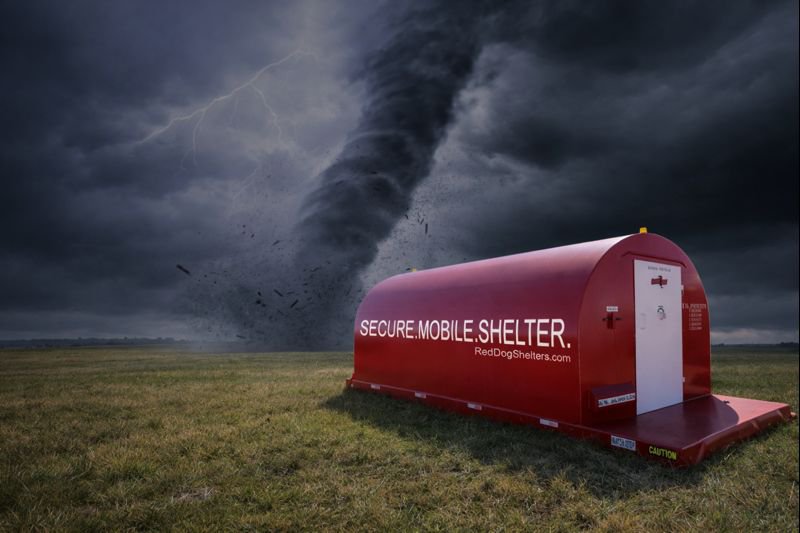
Red Dog Shelters uses a patented aerodynamic anchoring system that sidesteps this problem entirely. As wind speeds rise, the shelter's geometry creates a downward pressure differential. This pulls the unit tighter to the ground. The effect is passive and self-energizing. The faster the wind, the stronger the downward force. No mechanical anchors, no concrete, and no site modification are needed.
As a result, a unit deploys on dirt, gravel, or asphalt in under 10 minutes.
Wind Shelter Mobility Keeps Protection Current as Sites Evolve
Work zones shift on construction and drilling sites. A shelter placed correctly in month two of a project may be poorly positioned by month six. Fixed solutions handle this poorly. Above-ground wind shelters solve it.
Clients can reposition units themselves if they have the equipment. Alternatively, Red Dog handles repositioning using a flatbed winch truck. Either way, the shelter moves without the site disruption that underground alternatives create.

This flexibility also supports scaling. As crew size grows, additional wind shelters can join the deployment. As the project winds down, units can leave. For a practical look at how this works logistically, the portable storm shelter transport overview walks through delivery, placement, and repositioning from start to finish.
Wind Shelters Serve More Than Tornado Response
Industrial wind shelters often earn their place on a site through more than tornado protection alone.
Red Dog units feature solid steel enclosures that also act as Faraday cages. This gives workers protection from lightning-related electrical hazards during severe electrical storms. Additionally, these shelters work as muster points during other emergencies, including blast events and pressure incidents common in petrochemical environments.
That broader utility gives operations managers a safety asset that stays relevant year-round, not just during peak tornado season. For sites weighing dual-use protection, the above-ground blast and storm shelter overview explains how the same design that stops debris also handles blast pressure scenarios.
Getting Wind Shelter Strategy Right
Debris impact risk on remote sites is predictable. The storms that create it are not. That gap is where shelter strategy either holds or breaks down.
The right wind shelter approach brings together four elements: certified debris-resistant construction, correct placement relative to active work zones, terrain-appropriate anchoring, and the flexibility to reposition as the site evolves. Together, they function as a system. Individually, each one has a gap the others cannot fill.
Red Dog Shelters addresses all four in a single deployable unit. No foundation work, no extended setup time, and no compromise on structural ratings. Contact us to learn more or order.