
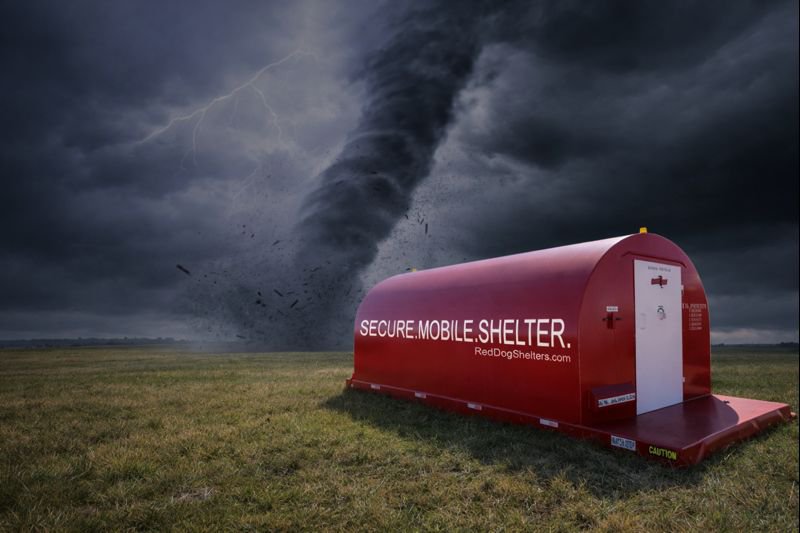
When a tornado approaches an active job site, above-ground tornado shelters are only as reliable as the system holding them in place. For safety directors, EHS leaders, and operations managers, that anchoring question drives every shelter evaluation. Understanding the engineering behind aerodynamic anchoring helps teams make decisions that hold up under scrutiny and under storm conditions.
Why Traditional Above-Ground Tornado Shelter Anchoring Falls Short
Traditional above-ground tornado shelters rely on mechanical anchoring. Crews drive steel stakes, pour concrete pads, or bolt hardware into the ground to hold the structure in place.
Mechanical anchoring works in controlled conditions. However, it creates real friction on active job sites:
| Challenge | Operational Impact |
|---|---|
| Site preparation required | Adds time and cost before the shelter is usable |
| Hard or rocky ground | Makes installation difficult or impossible |
| Shelter relocation | Requires full anchor removal and reinstallation |
| Phased projects | Repeated disassembly and reinstallation throughout |
For construction crews and oilfield operators working across changing terrain and evolving site layouts, these constraints add up fast. This is especially true on sites with rocky or compacted terrain, where mechanical anchoring may not be viable at all.
How Aerodynamic Anchoring Works in Above-Ground Tornado Shelters
Red Dog Shelters developed a patented approach that solves this problem differently. Instead of resisting wind force through fixed hardware, the shelter's geometry uses wind force to push the unit toward the ground.
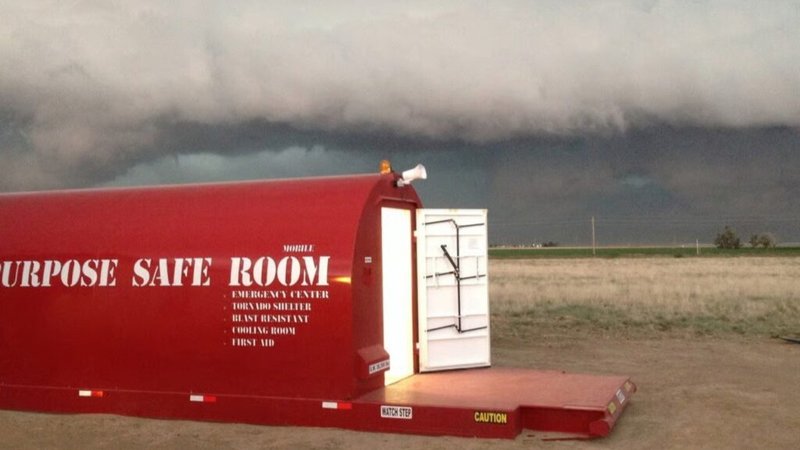
The principle follows Bernoulli-based aerodynamic behavior. As wind speeds increase around the shelter's profile, a pressure differential builds between the top and bottom surfaces. That differential creates a downward force on the structure. Furthermore, as the storm intensifies, the downward force increases proportionally.
Key engineering characteristics of the aerodynamic anchoring system:
- Passive operation: No pump, no active mechanism, and no seal dependence
- Self-energizing: Wind drives the downward force, and it scales with storm severity automatically
- Surface-independent: Works on dirt, gravel, asphalt, or grass without ground preparation
- Instant securing: The above-ground tornado shelter is anchored as soon as it is placed
Red Dog's aerodynamic anchoring is covered under multiple U.S. patents and tested at the Texas Tech Wind Science and Engineering Research Center. As a result, the shelters meet the performance thresholds required under FEMA 361 and FEMA 320 guidelines, ICC 500, and NSSA standards. It is also worth noting that not all shelters marketed for storm protection meet these thresholds, which makes third-party certification a critical part of any above-ground tornado shelter evaluation.
Deployment Speed: Above-Ground Tornado Shelters Without the Wait
Because aerodynamic anchoring requires no mechanical installation, deployment is fast and straightforward. The larger commercial unit deploys in under ten minutes. The towable model positions in under thirty seconds.
| Unit | Mobility Method | Mobility Method |
|---|---|---|
| Big Dog (Commercial) | Under 10 minutes | Flatbed winch truck |
| Tow Dog (Mobile) | Under 30 seconds | Standard pickup truck |
That speed matters when weather windows are short and project schedules leave no buffer. It also matters significantly for remote oilfield sites where mobilizing labor for foundation work adds days to a timeline. Above-ground tornado shelters with aerodynamic anchoring eliminate that delay entirely. For a closer look at why underground alternatives create additional challenges on temporary lease sites, that comparison is worth reviewing before committing to a shelter strategy.
Structural Design That Supports the Engineering
Aerodynamic performance depends on geometry. However, above-ground tornado shelters also have to survive direct structural loading from wind, debris impact, and pressure changes.
Red Dog shelters use reinforced A36 steel, a structural grade common in commercial construction and industrial fabrication. The enclosure is engineered to resist:
- EF5-level wind loads exceeding 250 mph sustained winds
- High-velocity debris impact from objects up to 20,000 pounds
- Industrial blast overpressure from petrochemical events
That last point matters for oilfield and energy sites. The same construction that handles tornado conditions also handles industrial incidents. So these units serve as multi-purpose safe rooms with above-ground blast shelter capability across environments where both weather risk and process hazards exist simultaneously.
Scalability: Matching Above-Ground Tornado Shelter Coverage to Project Size
One of the strongest operational advantages of aerodynamically anchored above-ground tornado shelters is how easily they scale with a project.
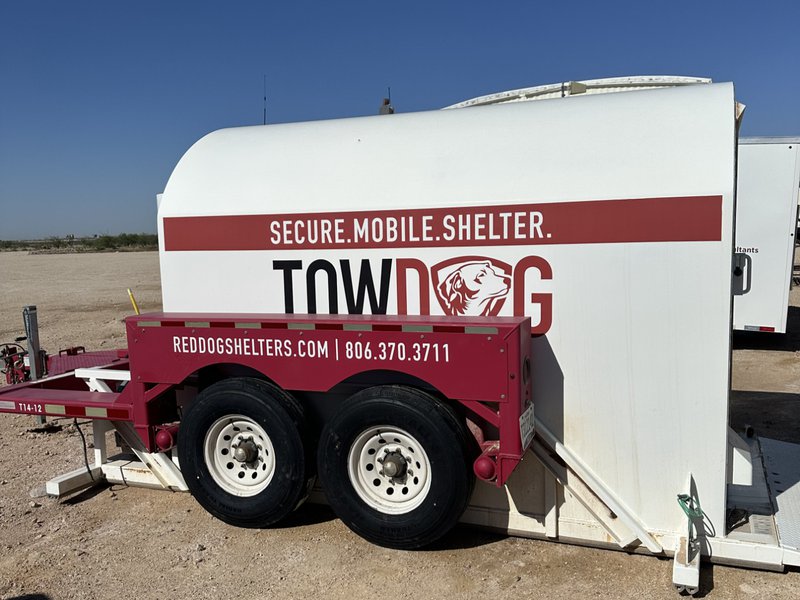
As headcount grows, teams can add units and distribute them across work zones. As a project winds down, they can remove or consolidate units without dismantling anchor hardware. Red Dog repositions units using a winch truck, or operators with the right equipment can move them independently. For a detailed look at how Red Dog shelters are transported and repositioned across active sites, the logistics are more straightforward than most teams expect.
Consider a large construction site where workers are spread across multiple work zones. A single shelter near the site entrance may not help a crew working half a mile away when a fast-moving storm develops. Distributing above-ground tornado shelters across the project solves that response-time problem directly. Because repositioning requires no anchor removal, the shelter layout can change as the project layout changes.
Evaluating Above-Ground Tornado Shelter Options: A Decision Checklist
When reviewing above-ground tornado shelter options for a project, the engineering basis for anchoring deserves direct attention.
| Evaluation Factor | Evaluation Factor |
|---|---|
| Anchoring method | Passive aerodynamic vs. mechanical installation |
| Relocation process | Can it move without anchor removal? |
| Surface compatibility | Does it require prepared ground? |
| Third-party testing | What standard and institution verified performance? |
| Certification coverage | Does it meet FEMA 361, ICC 500, and NSSA requirements? |
| Deployment timeline | How quickly can the shelter be operational? |
Aerodynamic anchoring addresses most of these factors by removing installation complexity from the equation. The shelter's rated performance comes from geometry, materials, and third-party testing, not from hardware that needs reinstallation every time the project evolves. For projects weighing longer-term commitments, it is also worth reviewing whether purchasing or leasing an above-ground tornado shelter fits the project timeline before making a final decision.
The Right Engineering for Sites That Change
Above-ground tornado shelters built around aerodynamic anchoring take a different approach than traditional fixed solutions. They prioritize mobility without giving up rated performance. That tradeoff fits the operational reality of construction, oilfield, and industrial projects where conditions shift throughout the project life.
For safety and operations professionals currently evaluating shelter options, the engineering behind anchoring is the right place to start.
Contact Red Dog Shelters to discuss your site layout, crew size, and project timeline.