

Most data center EHS programs have a gap: safety shelters for outdoor crews. The main building protects staff working inside. But contractors, technicians, security staff, and maintenance workers outside face a real severe weather risk. Open terrain and short warning times make that risk hard to ignore.
Data centers are not immune to tornadoes. In fact, many sit on flat, open campuses in regions with an active tornado history. Yet outdoor crew protection often gets treated as a secondary concern. That is a problem worth fixing now, not after an incident.
Why Safety Shelters Belong in Your Data Center EHS Plan
A data center campus looks different from an oil field. Even so, the weather risk dynamics are more similar than most EHS leaders expect.
Here is the typical scenario:
- Contractors often work in parking lots, equipment yards, or along perimeter infrastructure far from the main building
- Security and operations staff rotate through outdoor posts on scheduled cycles
- Construction and expansion crews may work on-site for months in open-field conditions
- A severe weather alert can come as little as 10 to 15 minutes before a tornado touches down
As a result, routing every outdoor worker through one building entry creates a dangerous chokepoint. Both response time and distance to shelter matter.
Placing safety shelters at points across a large campus cuts travel distance and response time together. That is a direct EHS win, not just a logistics preference.
Multi-Purpose Safety Shelters: More Than Tornado Response
Above-ground safety shelters do more than protect against tornadoes. In fact, a well-built certified unit covers several threat types that data center sites face regularly.
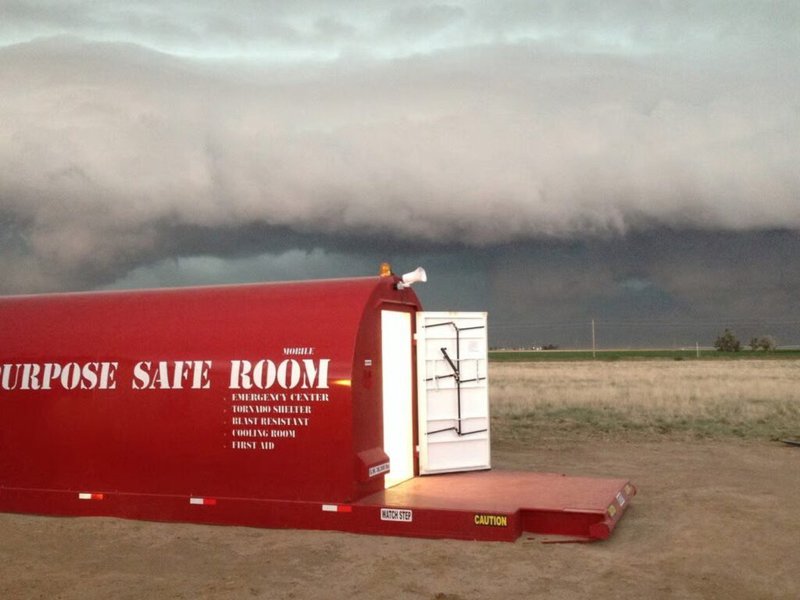
Tornado and high-wind protection is the core use. A shelter rated to FEMA 361 and ICC 500 gives crews a safe space when they cannot reach the main building in time.
Lightning and electrical storm response adds a second layer. Workers caught in open areas during a lightning event need a grounded, shielded space fast. A steel shelter acts like a Faraday cage. This reduces exposure risk even during storms that fall below the formal alert threshold.
Heat emergency response is equally practical. Data centers in the Southwest, Plains states, and Gulf Coast expose outdoor workers to serious heat risk. Above-ground safety shelters with dual HVAC systems and rapid cool-down stations give workers relief during heat emergencies, not only during storms.
Emergency mustering rounds out the list. When an event inside the facility requires evacuation, distributed shelters give EHS teams clear, hardened assembly points. As a result, accounting for all personnel becomes faster and more reliable.
In short, one certified safety shelter unit handles all four functions. That changes the cost-benefit picture considerably.
Deployment Realities for Safety Shelters on an Active Campus
Fixed underground shelters and poured concrete safe rooms rarely fit data center EHS programs well. This is especially true during construction phases, tenant expansion, or periods when headcount shifts often.
The core deployment challenges are:
- Excavation conflicts with active facilities, paved surfaces, and dense underground infrastructure
- Headcount changes as phases ramp up and wind down, making fixed-capacity solutions wasteful
- Campus layout shifts as new buildings, cooling systems, and power infrastructure come online
Above-ground safety shelters solve all three problems. Crews place units on gravel, asphalt, compacted dirt, or grass with no foundation work at all. Moreover, no mechanical anchoring or concrete pad is needed, so placement skips the ground-work approval process entirely.
When the site layout changes, crews move shelters to match. Once a construction phase ends, units leave the site cleanly. When headcount grows, teams add units rather than modify existing structures.
Simply put, that level of flexibility does not exist with any fixed shelter option.
Compliance and Certification for Safety Shelters
EHS directors at data centers answer to both internal safety standards and outside frameworks. Severe weather protection for outdoor workers falls under OSHA General Duty Clause rules. Beyond that, it now appears more often in contractor safety requirements from major hyperscale operators.
Safety shelters in a formal EHS program should meet or exceed:
- FEMA 361 and FEMA 320 safe room design guidelines
- ICC 500 storm shelter construction standards
- NSSA (National Storm Shelter Association) certification requirements
Third-party engineer stamping on each unit creates records that hold up in internal audits and contractor reviews. In addition, knowing the difference between certified shelters and uncertified options is a key step before any purchase or lease decision.
How Red Dog Shelters Supports Data Center EHS Programs
Red Dog Shelters builds FEMA-rated, above-ground safety shelters for industrial sites where fast setup and mobility are must-haves.

Key features for data center EHS programs:
- 32-person capacity (Big Dog model) fits large contractor crews in one area
- Dual HVAC systems with rapid cool-down for heat emergencies
- 128 dB siren alarm and strobe lights for active weather alerts
- Setup in under 10 minutes with no foundation or anchoring required
- Patented aerodynamic anchoring creates a downward force that grows with wind speed, so the unit holds firm without stakes or bolts
- Leasing options that scale with the project and end when the phase does
Major operators like Chevron, Shell, and BP have used Red Dog units on high-risk sites. The same design that meets petrochemical safety standards also fits data center campus needs.
Building Safety Shelter Coverage Into EHS Planning
Severe weather protection for outdoor workers belongs in the first draft of any data center EHS plan. Adding it after an incident costs more and protects fewer people.
Before finalizing your plan, ask these questions:
- Where on the campus are workers most exposed when a storm moves in fast?
- How long does it take to reach the nearest hardened structure from those spots?
- Does the plan account for contractor headcount during construction phases?
- Do your safety shelters carry FEMA and ICC 500 certification?
If any answer reveals a gap, above-ground safety shelters are a direct fix. They arrive fast, scale with the project, and cover more threats than a tornado response alone.
Contact Red Dog Shelters to talk through your campus layout and headcount. The team can help you find the right placement, pick the right unit size, and set up a lease that fits your schedule.