

Implementing severe weather risk management on remote industrial sites tends to be stronger on paper than on the ground. The hazard identification is usually accurate: tornado risk, wind damage, debris impact, crew exposure on open terrain. Response protocols follow logically: shelter-in-place procedures, personnel accounting, communication chains. The weak point is the physical infrastructure behind these protocols. The designated shelter is often a construction trailer that was never engineered to survive the event the plan describes.
Severe Weather Risk Management: Engineering Controls Over Administrative Controls
OSHA's Recommended Practices for safety and health programs rank engineering controls above administrative ones in the hazard prevention hierarchy. A written emergency action plan with designated shelter locations and evacuation routes is an administrative control. A certified storm shelter rated to FEMA P-361 and ICC 500 is an engineering control. It only counts if crews can reach it within the warning window. Both belong in a complete severe weather risk management program, but the engineering control is what physically protects workers when winds exceed 200 mph.
Red Dog Shelters' Big Dog units carry third-party certification to meet or exceed FEMA P-320, FEMA P-361, ICC 500, and NSSA requirements. Impact testing at the Texas Tech Wind Science and Engineering Research Center confirmed debris resistance at FEMA's specified thresholds. A separate blast test by the Southwest Research Institute subjected a unit to a 2.77-million-pound impulsive force, producing winds beyond EF-5 strength. Construction is 100% A36 structural steel, with a 300-pound secured door, fireproof walls, and debris protection. This protection is rated for a 20,000-pound truck driven by EF-5 winds.
Shelter Placement as a Coverage Problem
A risk management plan that names one shelter for a 200-acre site has a coverage gap. OSHA's tornado preparedness guidance recommends that employers identify shelter locations accessible to all personnel. Tornado warnings can provide as little as a few minutes of lead time. A single shelter at the project office leaves every worker beyond a five-minute walk unprotected when the math runs out.
Red Dog's Big Dog units measure 35 feet long by 8.25 feet wide. Each holds 32 occupants under the FEMA commercial standard of 5 square feet per person. This is applied to 160 square feet of usable floor area. A 96-worker site spread across three active zones needs three units, not one oversized shelter at the front gate.
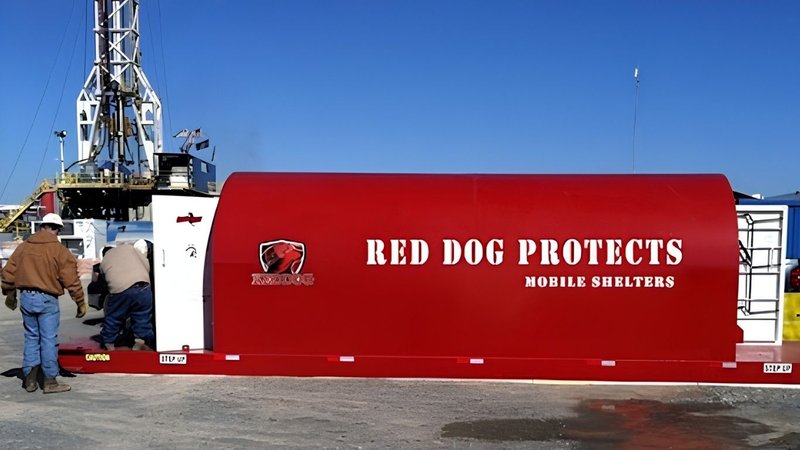
Patented Aerodynamic Anchoring makes this distribution practical. Two vacuum tubes in the curved roof create a pressure differential that holds each unit to flat ground, with the force increasing as wind speed rises. No foundation, no bolts, no excavation. Placement is driven by coverage geometry, not by where the ground can support concrete.
Safety directors comparing shelters from different manufacturers should confirm which standard a capacity figure uses. It might be the FEMA commercial standard, or the more permissive residential standard of 3 square feet per person. The residential rate produces higher numbers from the same floor area, but it doesn't reflect standards for commercial and industrial occupancy.
Adapting Coverage as the Project Moves
Fixed underground shelters lock a risk management plan to its Phase 1 assumptions. The workforce in month three rarely occupies the same footprint as the workforce in month ten. Early earthwork concentrates crews in one area. Peak structural work spreads them across the full site. A shelter installed for the original layout stays in position regardless of where the work migrates.
Red Dog's lease model handles this shift directly. Units go on lease as headcount grows and come off as the job winds down. Customers reposition shelters themselves if they have the means, or Red Dog sends a winch truck.
Because Aerodynamic Anchoring leaves nothing in the ground, relocation runs on the same timeline as initial placement. Delivery from yards in Moore, Oklahoma; Minden, Louisiana; and Lubbock, Texas takes 24 to 48 hours. A risk management plan anticipating a workforce doubling in month six can have added certified shelter on site within two days.
Risk Reduction Beyond the Compliance Checkbox
Severe weather risk management is partly regulatory and partly financial. A tornado event on a site with no certified shelter creates liability, regulatory scrutiny, and reputational exposure. This exposure far exceeds the cost of the protection that would have prevented it. Some operations teams have found that certified storm shelters affect insurance premiums and strengthen their risk profile with underwriters, particularly on projects in tornado-prone states.
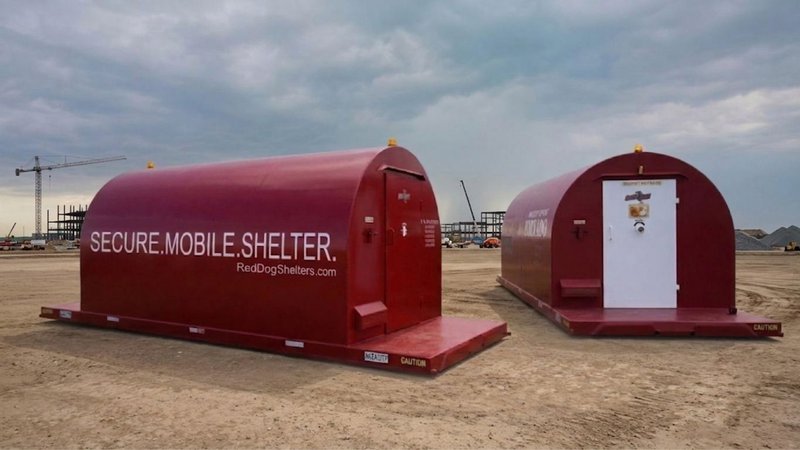
The financial case extends to downtime reduction. A site with no certified shelter evacuates entirely during a tornado warning. A site with distributed Big Dog units executes a shelter-in-place response that keeps crews on the property. The difference between a full evacuation and a 30-minute shelter event shows up in lost production hours, idle equipment, and schedule recovery costs.
Severe Weather Risk Management Performed Year-Round
Each Big Dog includes dual air conditioners, heaters, bench seating, and a desk as standard equipment. It also comes with a 128-decibel siren alarm, strobe lights, emergency lighting, and a Rapid Cool Down station. Between storm events, the same unit works as a cooling station for summer heat stress or a warming room in winter. It also serves as a muster point, a training space, or a temporary field office. The Faraday cage design adds lightning protection when properly grounded, covering another severe weather need from the same piece of equipment.
The risk of tornadoes concentrates in spring and summer across the central United States. However, heat stress, cold stress, and lightning operate on their own schedules. A shelter that addresses all four hazards using a single footprint simplifies planning and procurement. It also keeps the equipment earning its lease cost twelve months a year instead of sitting idle between storm seasons.
Above-ground storm shelters that deploy in minutes and relocate without a foundation give safety directors a way to match engineering controls to real risk. As the workforce scales and the project footprint shifts, the protection shifts with it. Lease a Red Dog Shelter and start adding certified severe weather infrastructure in your risk management plan.