

Shopping for storm protection at an active job site brings up one confusing phrase fast: patented anchoring. When you search for above-ground storm shelters for sale, sellers throw around anchoring claims that mean very little. Real anchoring performance depends on physics, testing, and proof, not marketing language on a spec sheet.
You need a clear way to sort real engineering from clever wording before you sign a contract. Here's what patented anchoring should actually mean, and what proof to demand from any seller. We will also cover certification, capacity math, and how easily a unit moves once conditions change.
What Does Patented Anchoring Mean for Above-Ground Storm Shelters?
Patented anchoring means a tested, engineered method holds the shelter down without bolts or a foundation. In Red Dog Shelters' design, two roof-mounted vacuum tubes create a pressure differential that presses the unit downward. The force grows as wind speed rises, so the shelter holds tighter exactly when a storm hits hardest.
How Patented Anchoring Actually Works on Above-Ground Storm Shelters for Sale
Most shelters on the market still rely on old-school anchoring: bolts driven into concrete, or a poured slab. Mechanical anchoring can work, yet it demands site prep, cure time, and a crew trained to install it right. Patented aerodynamic anchoring skips all of that by using wind itself as the holding force.
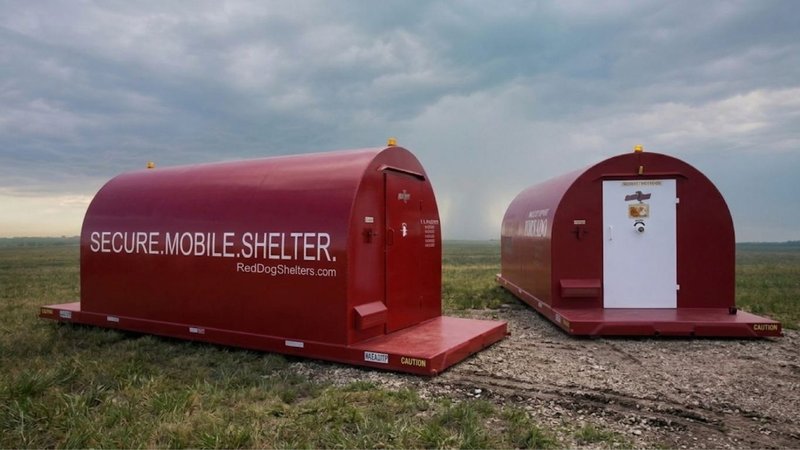
Engineers avoid the word suction on purpose, since suction implies an active pump or a tight seal. A pressure differential is different: it is passive, self-energizing, and grounded in basic Bernoulli principle physics.
No seal has to hold and no motor has to run for this anchoring to work. For a buyer comparing above-ground storm shelters for sale, this distinction changes what tested should even mean. Ask whether anchoring performance was engineered and verified, or simply assumed from a bolt pattern on paper.
No mechanical anchoring or foundation work also means faster setup and less ground disturbance at your site. You can place the shelter on gravel, dirt, or a pad without pouring anything or drilling a hole. Read more about aerodynamic anchoring in practice before you compare it with bolted mechanical systems.
Above-Ground Storm Shelters for Sale: What to Verify Before You Buy
Not every seller can back up big claims about wind resistance, so ask for real numbers first. Independent certification from a group like the National Storm Shelter Association (NSSA) is a strong starting point. A shelter tied to Federal Emergency Management Agency (FEMA) P-361 guidance also gives you a documented performance baseline.
How Is Wind and Debris Resistance Tested?
The International Code Council (ICC) 500 standard drives most of this testing, according to FEMA's ICC 500 summary. Shelters that fail engineering calculations alone must pass real missile impact tests before they earn approval. Test missiles strike at speeds tied to the shelter's rated wind speed and the storm type involved.
Occupant capacity claims deserve the same scrutiny as wind and debris ratings printed on any spec sheet. FEMA's commercial storm shelter standard allows 5 square feet per person, while the residential standard allows only 3. Some sellers of above-ground storm shelters for sale quietly use the smaller residential number to inflate their max occupancy.
Our own Big Dog cabin measures 20 by 8 feet, or 160 square feet of usable floor space. Divided by 5 square feet, that gives a rated capacity of 32 people, not a padded estimate.
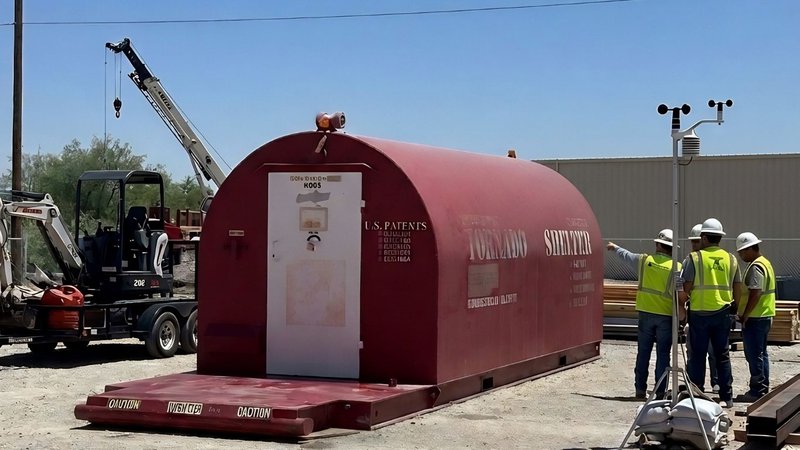
Always ask a seller how they calculated their number before you compare two shelters side by side. A shelter with a smaller footprint but an honest count protects your crew better than an inflated one. For a deeper breakdown, see this residential and commercial shelter guide before you compare sellers.
How Easily Can You Move or Scale a Shelter After You Buy It?
Buying is not the end of the decision, since your project site will keep changing after delivery. Ask how a shelter handles growth, shrinkage, and relocation before headcount or scope shifts on you. A shelter bolted to a slab is a one-time decision, but a mobile unit can adapt with the job.
- No bolts or foundation work means you can add units fast when a project ramps up.
- You can bring in more shelters as headcount grows and remove them as the job winds down.
- Compact units spread easily across a large site, so crews reach safety faster when storms build quickly.
- You can reposition a shelter yourself, or we can send a winch truck to move it.
- A steel shelter also works as a Faraday cage in lightning storms and a muster point in emergencies.
Flexibility like that is worth asking about before you shop for above-ground storm shelters for sale. Compare how each seller supports relocation, since a shelter you cannot move loses value as your site changes. Read our tips for transporting mobile shelters safely to see what smooth relocation actually looks like.
Above-Ground Storm Shelters for Sale: Ready to Compare Your Options?
Patented anchoring only matters if you can verify how it was tested and proven in the field. Ask every seller for certification records, wind and debris ratings, and an honest capacity calculation in writing. A shelter that moves with your project, instead of locking you into one spot, protects your budget too.
We built our anchoring system to skip bolts, skip foundations, and still hold firm in high wind. Pricing depends on your site, your timeline, and how many units your crew needs on hand. Contact our specialists today to get exact numbers for your next above-ground storm shelter purchase.
Leave a Reply