

A 400-acre solar farm build in western Oklahoma features a single storm shelter located near the project office at the main gate. The crew working the far southwest array is 12 minutes on foot from that shelter. A tornado warning typically provides only 8 to 13 minutes of lead time. While the shelter is fully certified, the location makes it unreachable for a third of the workforce. On-site safety stations solve this dilemma by distributing certified protection systems across the active work footprint. Instead of an arbitrary location right next to the entrance, the stations are placed where they’re needed the most.
Emergency action plans under OSHA's 29 CFR 1910.38 require employers to establish evacuation procedures and exit route assignments. Employers must also have methods to account for all workers after an emergency. On a compact commercial site, these routes lead to known locations within walking distance of every occupied room. On a sprawling industrial or construction site, the exit route during a tornado is the path between a worker's current position and the nearest hardened shelter. The length of this path determines how soon the worker arrives before the storm hits.
Why a Single Centralized Shelter Falls Short
Centralizing worker shelters in one location simplifies procurement and placement. Unfortunately, it also creates a bottleneck in the emergency plan that gets worse as the site grows larger. On a pipeline corridor stretching several miles, a single shelter near the midpoint won’t help crews at either end. Their travel distances can run into the thousands of feet. On a multi-phase construction site where the active work front moves as phases progress, a shelter designed for Phase 1 may end up far from Phase 3 operations. In many cases, this can reach a quarter mile within six months.
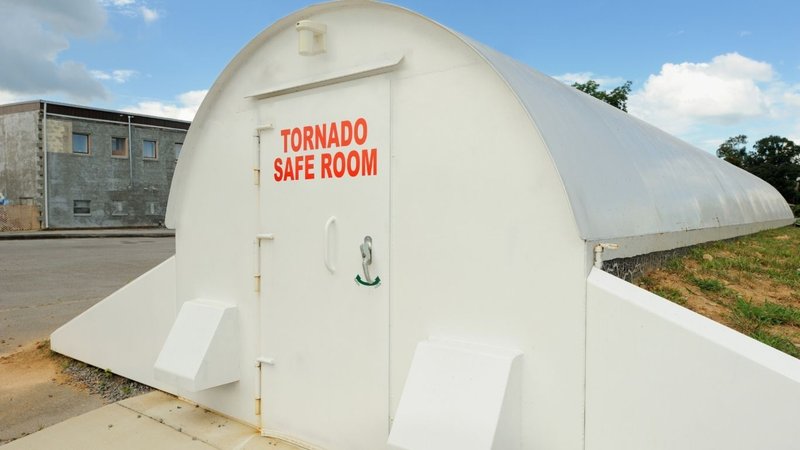
The problem compounds at shift change or during peak activity, when maximum headcount is spread across the widest area. A shelter rated for 32 occupants can only serve 32 people, regardless of whether 60 need protection at the same time. Undersizing means the first workers to arrive fill the certified shelter but leaves the rest outside during bad weather.
On-Site Safety Stations: Distributed Placement and Travel-Time Geometry
Distributing multiple on-site safety stations across the site converts the problem from a single-point bottleneck to a coverage geometry exercise. The goal is to position shelters so every worker can reach safety within the available warning window. In the central United States, this window typically runs under 10 minutes for a windstorm. OSHA's tornado preparedness guidance emphasizes that twisters can arrive with little or no warning. The proximity between workers and shelter locations becomes a direct factor toward the emergency plan’s success.
Red Dog Shelters' Big Dog units measure 35 feet long by 8.25 feet wide. This footprint fits between laydown yards, equipment staging areas, and access roads without blocking site traffic. Each unit holds 32 occupants under the FEMA commercial standard of 5 square feet per person. On a site with 96 workers spread across three active zones, three Big Dog units positioned at the center of each zone cover the entire workforce. Every crew member stays within a few minutes' walk of certified, FEMA-rated protection.
Laying out multiple shelters only works if placement and relocation are fast enough to keep up with a shifting work plan. Red Dog's patented Aerodynamic Anchoring removes the obstacle that usually prevents this flexibility. Two vacuum tubes in the curved roof structure create a pressure differential that anchors each unit to flat ground with increasing downward force as wind speed rises. This requires no foundation, no bolts, and no excavation. A Big Dog is secure the moment it touches the ground. Setup takes as little as five minutes, and repositioning runs on the same timeline.
Adjusting Coverage as the Site Evolves
On a 14-month construction project, the workforce footprint in month three rarely matches the footprint in month ten. Early earthwork concentrates crews in one area. Structural work spreads them across the full site. Mechanical and electrical trades may cluster in specific buildings while sitework crews remain outside. A fixed underground shelter installed during mobilization stays in its original position regardless of where the work migrates.
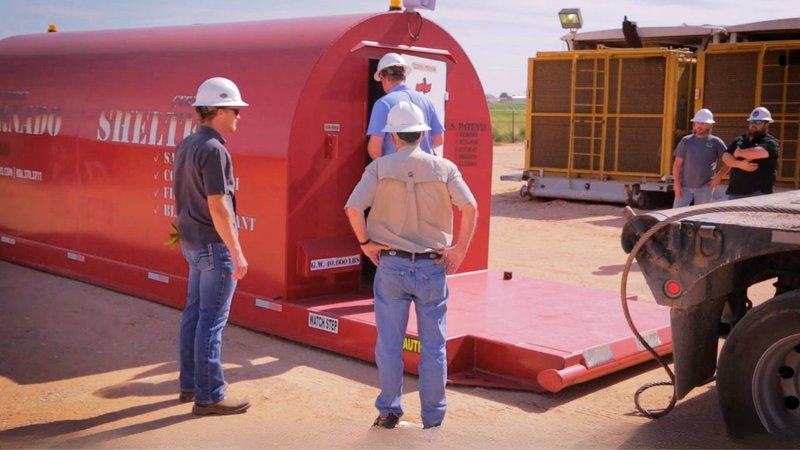
Red Dog's lease model and foundation-free anchoring let operations teams adjust shelter positions as the project evolves. Units can be added as headcount grows and removed as sections close out. They can also be physically relocated across the site as the active work front shifts. Customers can handle repositioning themselves if they have the equipment. Alternatively, Red Dog can dispatch a winch truck as part of the package. Delivery of additional units from Moore, Oklahoma, Minden, Louisiana, or Lubbock, Texas can happen as fast as 24 to 48 hours.
What Each On-Site Safety Station Provides Beyond Storm Protection
Each Big Dog includes dual air conditioners, heaters, bench seating, and a desk. It also comes with a 128-decibel siren alarm, strobe lights, emergency lighting, and a Rapid Cool Down station. On days without severe weather, these distributed stations serve as cooling stations during summer heat stress or warming rooms in cold weather. They also double as training spaces or muster points during non-weather emergencies. A site with three Big Dog units positioned across the project area has three climate-controlled spaces for daily operational use. This beats having three shelters sit idle between storm events.
All Big Dog shelters are made with 100% A36 structural steel and come with a 300-pound secured door, fireproof walls, and airtight debris protection. This assembly is rated to stop the impact force of a 20,000-pound truck driven by EF-5 winds. The units also function as Faraday cages when properly grounded, which adds lightning protection on sites using cranes or tall steel.
The difference between a shelter that exists on the site and one a worker can actually reach in time comes down to placement geometry. Distributing on-site safety stations across the active footprint turns a single-point solution into coverage that matches where crews actually work. Lease a Red Dog Shelter and put certified protection within reach of every crew member on your next project.