

Most data center infrastructure management strategies address power redundancy, cooling capacity, network routing, and physical security in detail. Workforce protection during severe weather events rarely gets the same treatment, and for sites in tornado-prone regions, that gap carries real operational risk.
Data center construction sites and operational campuses increasingly sit across Tornado Alley in Texas, Oklahoma, and surrounding states. The construction crews, commissioning engineers, and operations technicians on those sites face exposure that facility planners rarely model with the same rigor as uptime metrics.
Severe weather response needs to be treated as an infrastructure decision, not an afterthought.
Why Data Center Sites Carry Elevated Weather Risk
The geography of data center development has shifted significantly over the past decade. Large campuses now cluster in Texas, Oklahoma, and other states across Tornado Alley, driven by land costs, power access, and fiber infrastructure.
These locations offer clear operational advantages. The weather risk, however, is structural, not incidental.
During construction phases, crews work across open sites with limited natural shelter. Even after a facility goes live, exterior maintenance work, generator testing, landscaping operations, and expansion projects keep personnel in exposed conditions regularly.
A few factors compound the risk:
- Storm development speed. Severe weather in the southern plains can escalate from a watch to a warning in under 20 minutes, leaving limited time for workers to reach a safe location.
- Site size. A large data center campus can span dozens of acres. The distance from a far corner of the site to a building entrance is not trivial when a storm is approaching.
- Workforce density. During construction peaks, contractor headcount on a single site can reach several hundred people across multiple zones simultaneously.
The Gap in Data Center Infrastructure Management Planning
Standard data center infrastructure management (DCIM) frameworks address equipment uptime, thermal management, and power distribution with precision. Personnel safety planning during severe weather typically receives far less structured attention.
The common approach is to rely on building access as the primary protection strategy: when a warning is issued, get people inside. That works reasonably well for occupants of a completed facility. It works poorly for:
- Workers in external construction zones far from a finished structure
- Contractors who may not have access credentials to secure building areas
- Personnel operating outside during active commissioning tasks
- Sites where the primary facility is not yet enclosed or structurally complete
The result is a gap between the level of infrastructure investment in the facility itself and the level of protection available to the people building or maintaining it.
Shelter Placement as an Infrastructure Decision
Addressing this gap requires treating severe weather shelter placement as a site infrastructure question, not a reactive safety measure.
The same logic that drives decisions about transformer placement, cooling tower positioning, and cable routing applies here. Shelter locations should be determined by:
- Worker density zones. Where are the most personnel concentrated at any given phase of the project?
- Response time constraints. Can workers realistically reach the shelter within the warning window from their work zone?
- Site phase changes. As construction progresses, worker locations shift. Shelter placement needs to adapt accordingly.
For most large data center sites, a single centralized safe room inside the main structure is not enough to cover the site effectively. Distributed shelter placement, with units positioned across active work zones, dramatically reduces the distance workers must travel under time pressure.
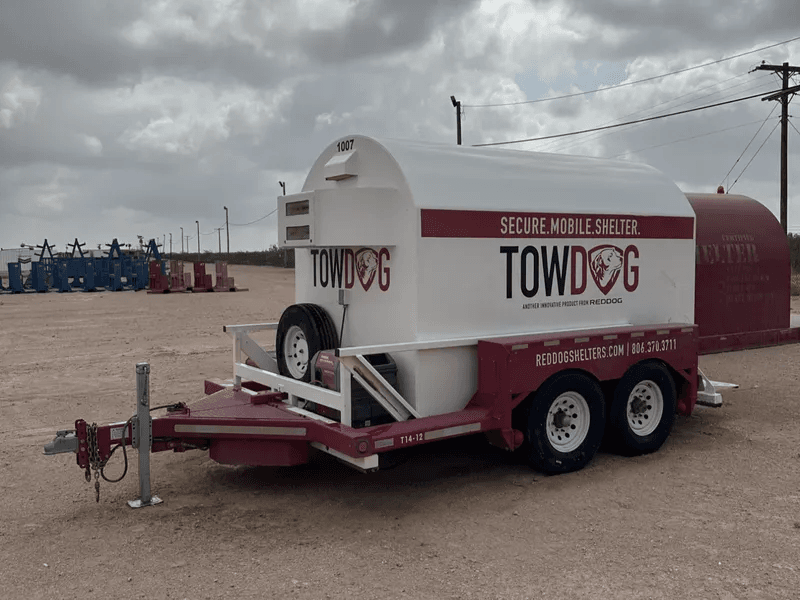
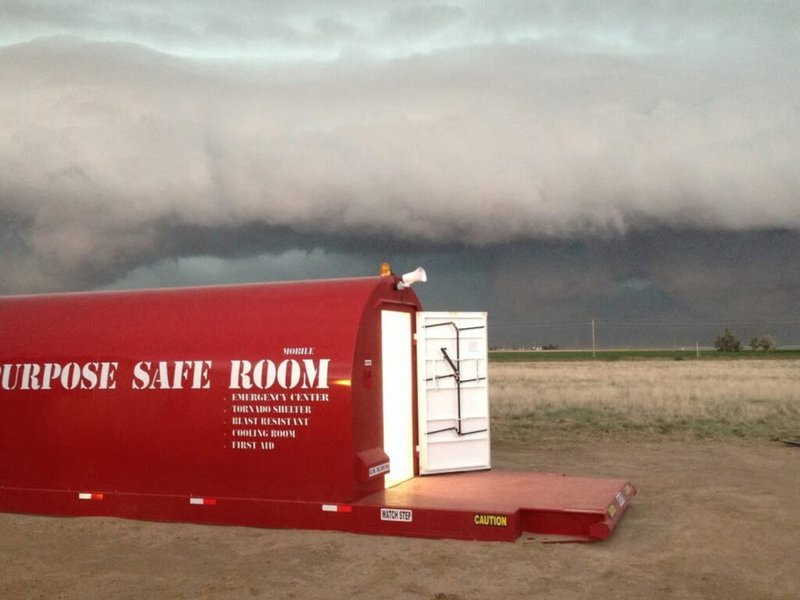
Red Dog Shelters' Big Dog units are built for exactly this kind of deployment. Each unit holds 32 or more personnel, requires no foundation work or mechanical anchoring, and can be placed on gravel, asphalt, or compacted dirt. That means a unit can go where the work is, not just where concrete has been poured.
As data center construction progresses through distinct phases, shelter positions can be adjusted. Red Dog units can be repositioned using a winch truck or moved by the site operator if they have the equipment to do so. No excavation, no permits for removal, no delay.
Multi-Purpose Value Beyond Tornado Protection
Severe weather shelter infrastructure also serves functions beyond tornado protection, which matters when justifying the investment to project stakeholders.
Red Dog shelters are engineered as Faraday cages, which eliminates the risk of electrical charge transfer during a lightning event. On a data center construction site where cranes, aerial lifts, and large metal structures are common, lightning exposure is a genuine operational concern, not just a weather footnote.
The units also function as muster points during other emergency scenarios, including fire evacuation staging, chemical release events, or security incidents requiring personnel accountability. On large campuses where worker accountability during an emergency requires a physical assembly point, a certified shelter positioned across the site perimeter provides that function without additional infrastructure.
Additional on-site utility includes:
- Crew rest and cool-down stations during high-heat construction periods
- Warming facilities during cold-weather work stoppages
- On-site meeting and briefing space when temporary office facilities are limited
For data center sites specifically, response time from distant work zones to shelter is one of the tightest operational constraints. Distributed placement across active campus zones addresses that constraint more reliably than relying on a single shelter point near the completed building.
Compliance Alignment
Data center operators and their general contractors operate under multiple safety frameworks. Shelter provisions for severe weather exposure are addressed in OSHA guidelines and reinforced by many owner-operator safety programs.
Red Dog units are individually certified to meet or exceed:
- FEMA 361 and FEMA 320 safe room guidelines
- ICC 500 standards for storm shelter design and construction
- NSSA (National Storm Shelter Association) standards
That certification matters during safety audits, insurance reviews, and owner-contractor safety evaluations. It also matters when EHS leadership needs to demonstrate that severe weather provisions meet recognized standards rather than rely on informal or improvised solutions.
Above-ground certified units also avoid the installation burden of in-ground alternatives. In-ground shelters on temporary lease sites require excavation, concrete work, and decommissioning costs that rarely fit construction project timelines or budgets.
Building Severe Weather Response Into the Site Plan
Data center infrastructure management continues to mature as facilities grow more complex and project timelines lengthen. Severe weather response deserves the same structured treatment as any other site safety system.
The framework is straightforward:
- Map worker density zones by project phase.
- Calculate realistic response times from each zone to available shelter.
- Identify gaps where existing building access does not provide adequate coverage.
- Position certified shelter units to close those gaps, adjusting placement as phases change.
The sites that handle this well do not wait for a weather event to find out whether their plan works.
Contact Red Dog Shelters to discuss shelter positioning for your data center site, explore leasing options, or evaluate coverage for a specific construction phase.