
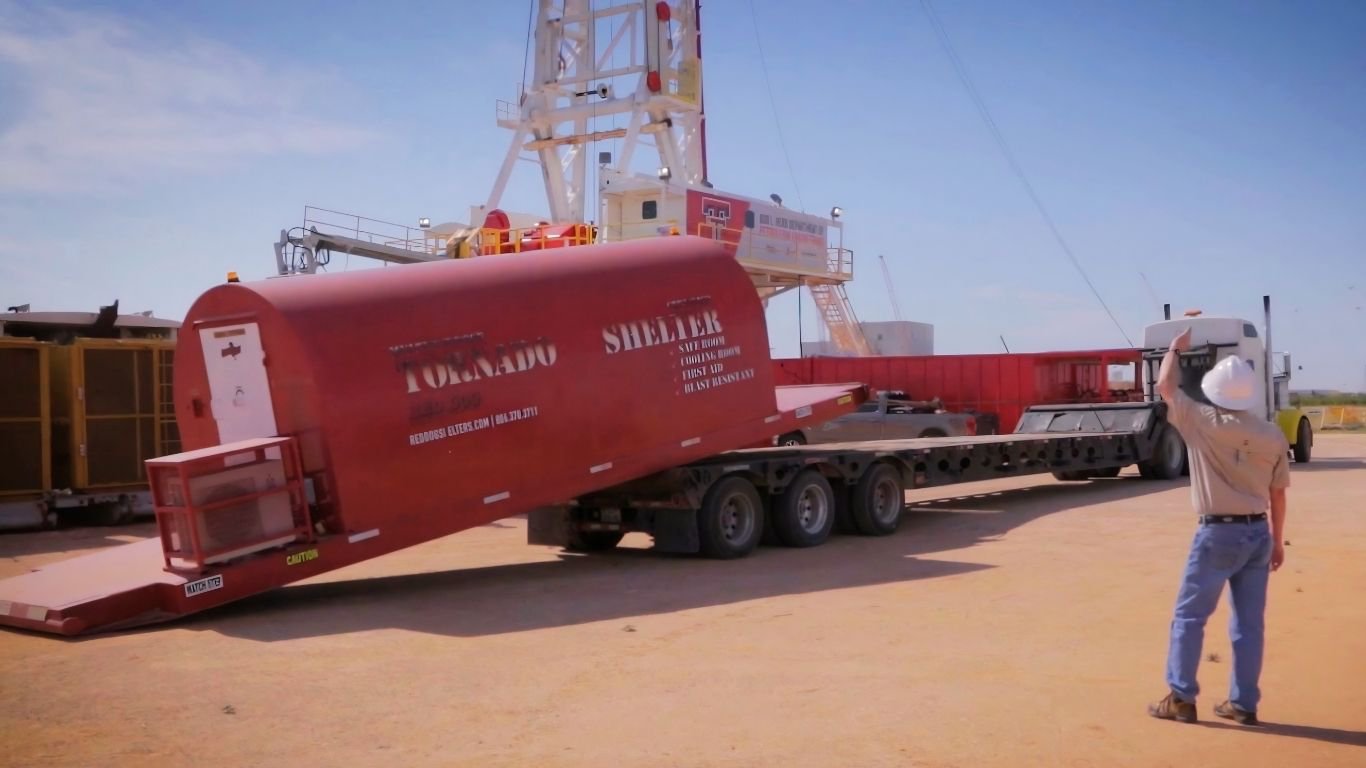
A construction project superintendent in West Texas has a problem that most EHS directors recognize immediately. Her site covers 40 acres. Her crew of 50 moves across three work zones as the project progresses. The nearest certified storm shelter is a concrete safe room bolted to the main contractor's office at the site entrance. It holds 20 people. Getting there from Zone C takes four minutes on a good day. When a tornado warning fires, she has two. Portable storm shelters positioned across the footprint would solve every part of that problem.
Yet many sites still rely on a single fixed structure and assume it covers the crew. As a result, the flexibility that portable storm shelters offer goes unused until a close call makes the gap obvious.
What FEMA-Rated Actually Means for a Portable Unit
Not every shelter marketed as portable carries FEMA-rated certification. The distinction matters. A FEMA-rated portable storm shelter must meet FEMA P-361 performance criteria. The structure must survive EF-5 wind loads and withstand a debris impact from a 15-pound 2×4 at 100 mph. That test covers the walls, door, and ventilation system.
In contrast, many portable enclosures on the market carry no such certification. They move easily and look similar to a certified unit from the outside. However, they have never been independently tested against the debris impact and pressure differentials that FEMA P-361 requires.
Red Dog engineers stamp and certify each unit individually. Units meet and exceed FEMA P-361, FEMA P-320, ICC 500-2008, NSSA standards, and OSHA requirements. Furthermore, the Texas Tech Wind Science and Engineering Research Center tested the design against the highest safe room rating available. That certification record is what separates a portable storm shelter from a portable enclosure.
How to Solve the Fixed-Location Problem
The core advantage of portable storm shelters on an evolving job site is placement flexibility. A fixed safe room anchored to a concrete foundation serves the work zone nearest to it. As the project footprint shifts, that advantage erodes. For instance, a drilling pad that expands outward over several months creates new zones. Workers in those zones may be well beyond a safe travel distance to the original shelter.
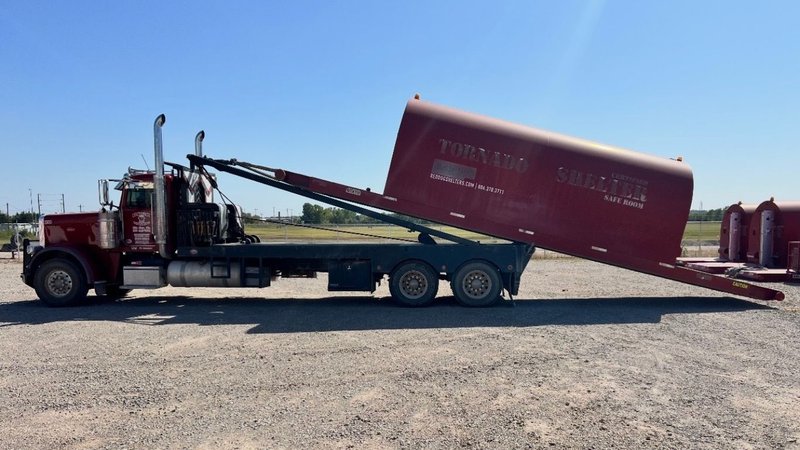
For that reason, the shelter solution has to move with the job. Red Dog Big Dog units need no foundation and no mechanical anchoring. The patented Aerodynamic Anchoring system locks each unit to flat ground using physics rather than bolts. The curved roof creates a low-pressure zone at the base under high wind loads. Two vacuum tubes transfer that pressure downward. As a esult, the shelter locks to the ground without bolts or stakes. The harder the wind, the tighter the hold.
Because crews skip anchoring setup entirely, a trained Red Dog team places a unit and it is ready in as little as five minutes. That means teams reposition portable storm shelters as work zones shift without foundation work, permitting delays, or downtime.
Distributing Portable Storm Shelters Across a Large Site
The right model for a large site is distribution, not centralization. Red Dog Big Dog units hold 32 people per FEMA standards and measure 35 feet by 8.25 feet. That size works well for deployment across construction and industrial sites because multiple units cover multiple zones simultaneously.
Similarly, the fleet scales with the project. Clients add units as headcount grows during peak phases and reduce the fleet as work winds down. That means the number of portable storm shelters stays matched to the actual crew count at every phase. Moreover, customers reposition units themselves if they have the means. If not, Red Dog dispatches a winch truck as project zones shift. Even so, each unit is secure as soon as it touches flat ground with no setup required beyond placement.
For sites in Texas and Oklahoma, Red Dog maintains yard locations in Lubbock, TX and Moore, OK for fast regional delivery. Units reach active sites within 24 to 48 hours.
Portable Storm Shelters as Multi-Purpose Site Assets
FEMA-rated portable storm shelters don't have to sit idle between severe weather events. Each Red Dog unit includes dual air conditioners and heaters. That makes it useful as a cool-down station in summer and a warming room in winter. Units also serve as on-site meeting spaces, training rooms, and emergency muster points.
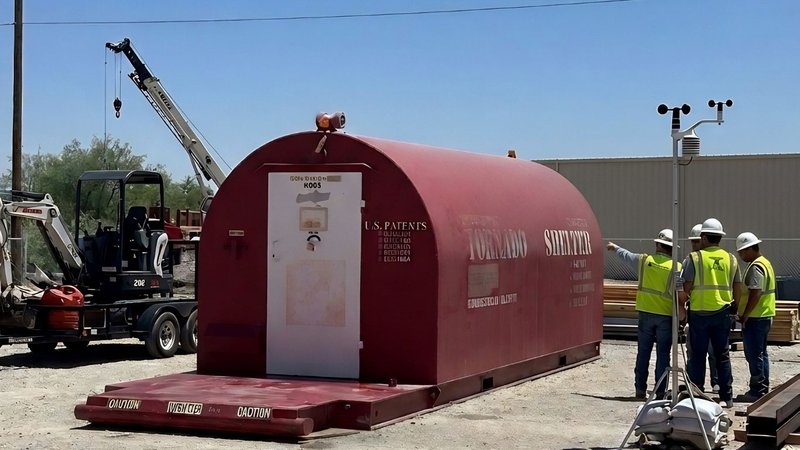
In addition, each unit acts as a Faraday cage when grounded. That protects crew members from high-voltage electrical charges during lightning events. For construction sites running electrical work near substations or transmission infrastructure, that adds a layer of daily protection beyond tornado season.
By contrast, a fixed safe room at one corner of the site delivers only one of these functions and only for crews that can reach it in time.
Evaluating Portable Storm Shelters Before You Sign a Rental Agreement
Before committing to a portable storm shelter rental, safety directors should verify three things. First, does the unit carry individual FEMA P-361 certification stamped by a licensed structural engineer? Second, does the deployment plan distribute units across the site footprint rather than centralizing coverage? Third, can units be repositioned as the project evolves without requiring new anchoring or permits?
Still, certification alone does not complete the picture. The anchoring method matters too. Units that require mechanical anchoring before they are secure add setup time and create a window of vulnerability between placement and protection. Red Dog units are secure the moment they touch flat ground. Therefore, the five-minute setup standard is not a selling point. It is a safety outcome.
In practice, the certification record on a portable storm shelter is the most important number on the spec sheet. It tells you what the unit will do when it matters, not what it looks like on a product page. You can review the ICC 500 storm shelter standard to understand what that record must demonstrate.
Ultimately, the right portable storm shelters are not the ones nearest to your site. They are the ones certified to protect your crew, distributed across your footprint, and ready to move as the project does.
Red Dog portable storm shelters are FEMA-rated, individually certified, and ready to deploy across your full site footprint. If your current shelter plan leaves any zone uncovered, connect with us to learn more or request a unit.