

Data center operators invest heavily in redundancy through dual power feeds, generator backups, cooling failovers, and network diversity. Formulating an emergency management program for data centers helps protect these investments throughout their lifecycle. Crews need a physical severe weather response capability that functions immediately during a tornado warning. This protection must cover every area of the site where personnel are active. Prioritizing system redundancy over physical crew protection implies that hardware takes precedence over the workforce. Doing the right thing means applying equal protection for both assets during severe weather events.
Any Emergency Management for Data Centers Program Should Cover the Construction Phase
Most data center emergency planning focuses on operational risks like power failures, cyber incidents, and facility impacts. The construction phase can last up to 36 months and carries the highest physical exposure for crews. This initial build phase often receives less formal attention in standard emergency plans. There are no permanent walls, no hardened structures, and no building core to shelter in. Personnel remain vulnerable on open terrain for the full duration of the project.

Occupational Safety and Health Administration (OSHA) guidance requires an emergency action plan that addresses site-specific weather hazards. Tornado risks represent a critical hazard for data center construction projects in the central and southern United States. Managing this hazard requires a physical shelter solution instead of a written protocol.
Shelter as Physical Infrastructure in the Emergency Plan
Identifying shelter locations, evacuation routes, and response protocols creates a baseline emergency plan. Adding certified shelters within a short distance of every active work zone makes that plan executable. This infrastructure distinguishes a theoretical paper procedure from a functional response during a narrow warning window.
Red Dog Shelters manufactures above-ground units with Federal Emergency Management Agency (FEMA) P-361 and International Code Council (ICC) 500 certification. Each unit protects 32 occupants based on the commercial standard of 5 square feet per person. They set up in as little as five minutes on flat ground, with no mechanical anchoring or foundation work. The Aerodynamic Anchoring™ system uses a passive pressure differential through vacuum tubes to secure the structure. This mechanism stabilizes the unit without relying on soil conditions. Heavy precipitation during severe storms frequently compromises ground stability, making anchorless design essential.
Safety managers distribute units across the data center footprint and adjust placements as construction phases evolve. Adding units during high-density phases maintains adequate coverage for the expanded workforce. Teams remove or reposition units as sections reach completion and crews consolidate. Project teams with the capability can handle moves themselves; Red Dog dispatches a winch truck for those that do not.
Integrating Shelter Into the Broader Emergency Plan
A comprehensive safety plan integrates physical shelters with communication systems and muster protocols. This coordination secures the site-specific tornado response procedure. Red Dog units include a 128-decibel siren and strobe lights to support site alerting functions. Internal emergency lighting protects occupant safety during a shelter event. Grounded all-steel construction functions as a Faraday cage. This configuration eliminates electrical charge buildup inside the unit during lightning strikes.
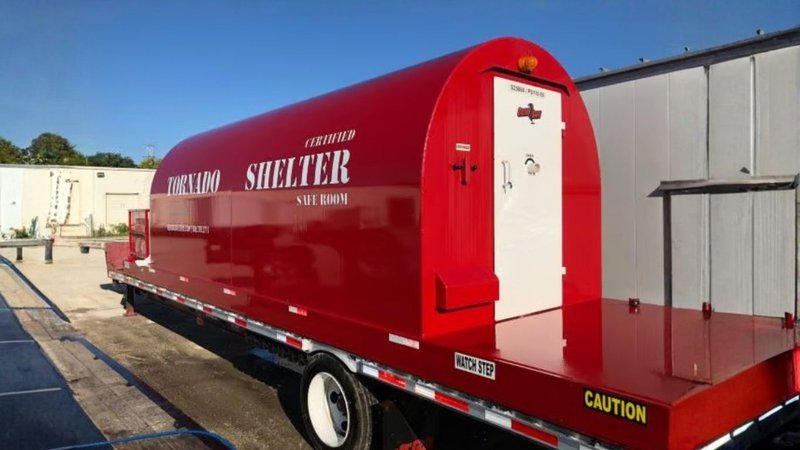
For data center Environmental, Health, and Safety (EHS) planning, the shelter serves as the physical refuge and muster point. The known location of the shelter provides a fixed reference point for crew accountability after storms pass. Personnel gather at a designated spot while coordinators verify headcount efficiently. This structure gives the response procedure a physical anchor.
Transitioning the Emergency Management for Data Centers Program to the Operational Phase
As a data center transitions from construction to operation, the emergency management plan needs to transition as well. Operational facilities feature permanent buildings but still require protection for outdoor maintenance crews and subcontractors. These personnel frequently service mechanical and electrical systems outside the main building envelope. Retaining a deployable above-ground shelter during operations provides continuous severe weather coverage for outdoor work zones.
Red Dog delivers units to data center sites nationwide within 48 hours. Management can modify lease structures as project requirements evolve. A single unit can protect construction crews in phase one and remain on site for operational teams in phase four. Certified physical shelter infrastructure makes every other safety protocol executable across multiple project phases. OSHA guidance also mandates that employers provide a safe workplace during emergencies. This responsibility remains continuous throughout the project timeline. It applies equally during early grading and final mechanical, electrical, and plumbing (MEP) installation phases.
A data center emergency management plan that addresses system redundancy without addressing crew shelter redundancy is incomplete. Contact us today, and we’ll be happy to discuss coverage, unit counts, and deployment logistics for Red Dog shelters.