
Industrial procurement often treats distinct storm shelter standards as interchangeable marketing stamps. That assumption creates an immediate compliance liability during a regulatory safety audit. For a safety director protecting a field crew, misinterpreting the operational boundary between the National Storm Shelter Association (NSSA) standard and FEMA P-361 leads directly to miscalculated asset footprints.
While both frameworks evaluate severe weather survival, they rely on entirely separate structural verification processes. Distinguishing what each certification confirms on a factory floor is a practical procurement requirement rather than an academic exercise.
What the NSSA Standard Measures
The NSSA developed the standard for the Design, Construction, and Performance of Storm Shelters in 2001. This text became the first industry benchmark for commerically-available tornado shelters. That document served as a foundation for International Code Council (ICC) 500. The International Building Code (IBC) now references this joint standard to regulate the physical execution of emergency protective structures. To earn NSSA Producer Member status, a manufacturer must secure independent verification from a qualified third-party engineering firm rather than relying on self-certification.

The NSSA membership rules require verified compliance rather than claimed compliance. An independent structural engineering firm reviews the design, structural calculations, and construction of any shelter carrying an NSSA mark. That review provides the validation that a manufacturer's self-certification lacks. This independent engineering loop ensures that structural elements, including welds, door hinges, and anchoring mechanisms, match specific severe-weather parameters before the unit ever arrives on a commercial facility plot.
What FEMA P-361 Measures
Meanwhile, the publication FEMA P-361 established performance criteria for shelters that receive federal funding or grants. This document provides guidance rather than an active building code standard. It defines structural loads and debris impact resistance under extreme atmospheric conditions. It also sets ventilation minimums, emergency lighting rules, and capacity rules.
The same engineering research base supports both federal guidelines and ICC 500 code requirements. The two documents cross-reference each other extensively across multiple updates. A shelter that meets ICC 500 generally satisfies FEMA P-361 criteria. However, the verification pathways remain distinct. Independent reviewers measure ICC 500 compliance against a consensus code enforced by local building authorities. Conversely, evaluators check FEMA P-361 compliance against federal guidance criteria to safeguard capital allocations.
Securing Both FEMA P-6361 and NSSA Storm Shelter Certifications Is Possible
For safety directors at oil and gas, construction, mining, or data center operations, both certifications address real procurement questions. The NSSA mark confirms that an independent engineering firm reviewed the specific product. The FEMA P-361 certification confirms that the shelter meets federal standards for high-occupancy commercial use under federal safety grant funding models.
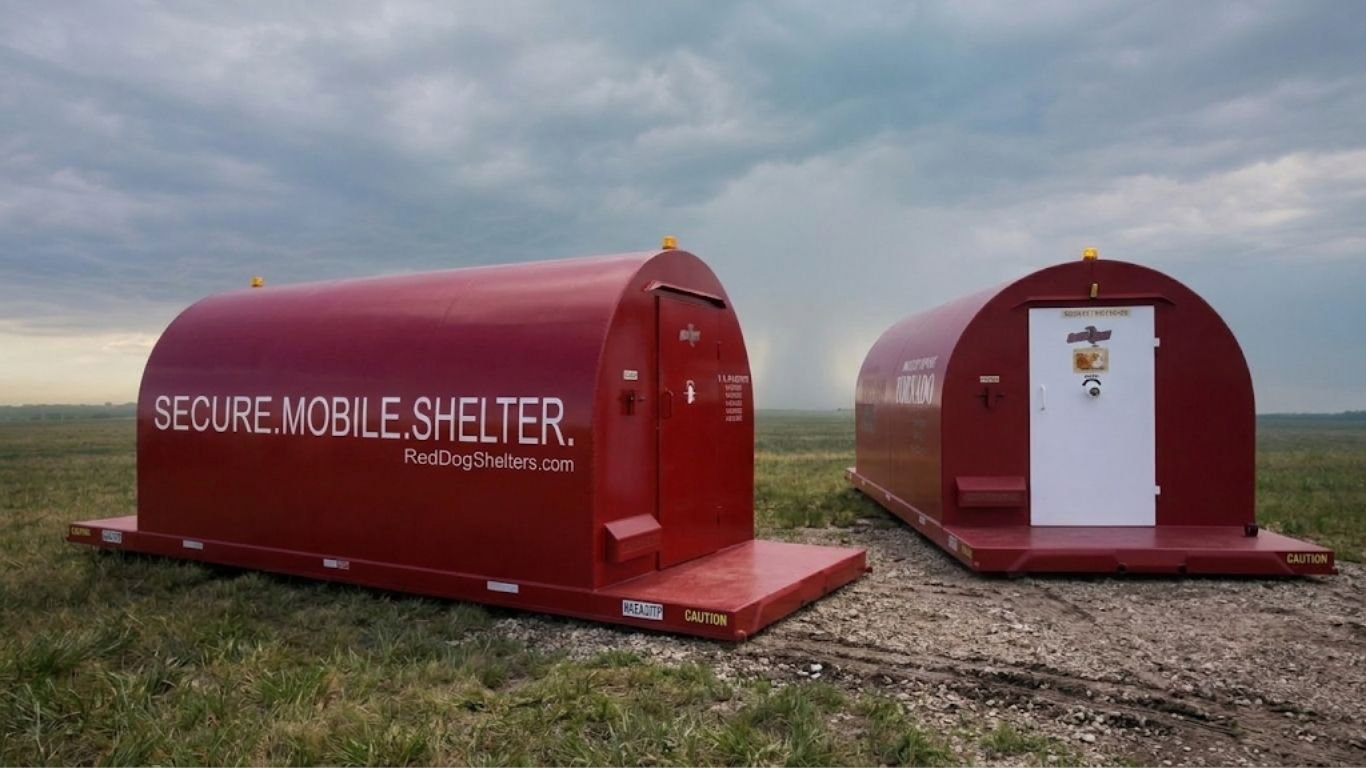
Red Dog Shelters' above-ground units carry both, along with FEMA P-320, ICC 500, Occupational Safety and Health Administration (OSHA), American Petroleum Institute (API), and ASCE 7-2005 certifications. A third-party structural engineering analysis stamps and certifies each unit to satisfy the NSSA verification requirement. The Texas Tech Wind Science and Engineering Research Center performed the debris impact testing on these units. This facility serves as a primary testing resource for federal safe room research and material certification.
The Capacity Standard Embedded in FEMA P-361
One certification-specific detail that has direct practical consequences is the FEMA P-361 capacity calculation standard. The federal commercial standard requires 5 square feet of usable floor area per occupant in a community safe room during a tornado event. Red Dog applies this rule to its 160 square feet of usable floor area, yielding a capacity of 32 people. This calculation ensures that emergency spaces have sufficient physical volume to accommodate personnel safely during extended weather disruptions without compromising breathable air.

Some vendors advertise higher capacities by using the residential standard of 3 square feet per person. That metric fits single-family homes rather than commercial installations. For a certified commercial deployment, the distinction matters significantly when calculating how many units a given crew density requires on a facility yard.
Understanding FEMA P-361 and NSSA Storm Shelter Requirements
Treating a data sheet certification mark as self-validating exposes a facility to compliance gaps unless buyers explicitly verify independent third-party evaluation logs. Confirming the specific edition of the engineering standard alongside the documented commercial capacity calculation ensures the shelter matches actual field risks before procurement.
Specifically, electric power and utility operations face strict compliance audits from safety regulators. Consequently, managers must document these details rather than accepting unverified claims. Red Dog Shelters provides full documentation for our line of commercial and industrial storm shelters. This package includes the third-party engineering stamp and the specific evaluation standards.
Reviewing vendor documentation directly against National Storm Shelter Association guidelines and FEMA P-361 criteria allows buyers to isolate unverified marketing claims before procurement. Grounding the selection process in these objective engineering benchmarks protects high-occupancy crews from structural failures during peak severe weather events.
For safety directors evaluating units and comparing documentation, contact us today. We’ll be happy to show you Red Dog Shelters’ certification package and discuss site-specific deployment.