
When a tornado warning fires across a large construction site, the incident commander's top challenge shouldn’t be about finding adequate shelter. The bigger directive is maintaining communication with supervisors spread across multiple work zones as conditions deteriorate. This coordination problem is what separates a basic shelter from a custom storm shelter configured as a working command hub. Safety directors are increasingly solving it through smarter shelter design rather than separate infrastructure.
Yet the standard job trailer has no answer for this. It provides no FEMA-rated protection, no communications infrastructure, and no documented incident management capability. A properly configured custom storm shelter addresses all three simultaneously.
What a Command Hub Configuration Actually Requires
Effective incident command during a severe weather event requires a specific set of capabilities. The site commander needs a certified structure that sustains communication with crew supervisors. The commander also tracks headcount, briefs incoming crew members, and documents decisions as the event unfolds.
The National Incident Management System identifies communications as one of the four core functional areas of incident management. For that reason, communications systems in an incident command environment must be interoperable, reliable, scalable, and resilient. A shelter that provides physical protection but cuts the incident commander off from the crew has failed half its function.
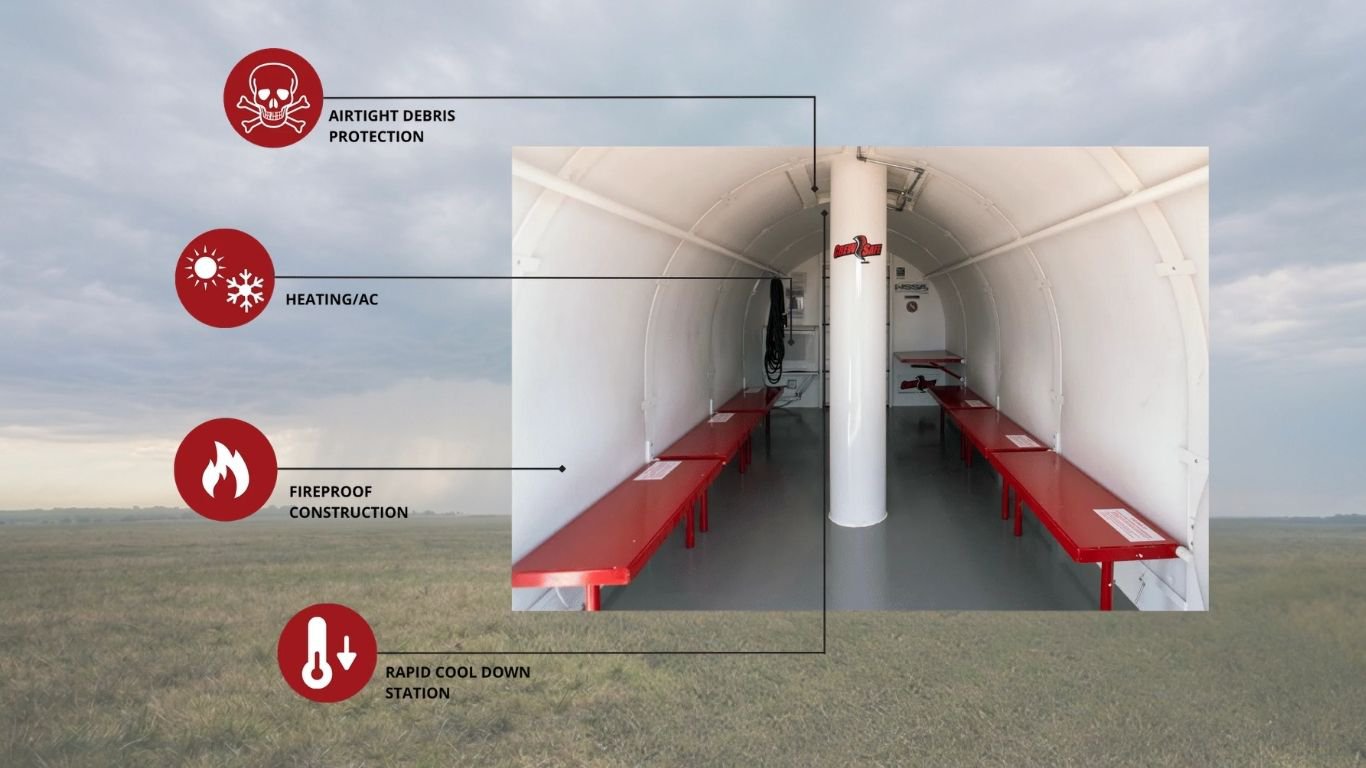
Red Dog Big Dog units come equipped with features that directly support command operations. Each unit includes a desk, bench seating for up to 32 people, emergency lighting, and a 128-decibel warning siren. Together, these features create a working environment that supports briefings, headcount management, and active coordination throughout any event.
Integrating Communications Technology Into a Custom Storm Shelter
The desk and interior layout of a Red Dog unit support the installation of radios, phones, laptops, and other communications equipment. Each unit runs on on-site power or a 5kW generator. As a result, communications technology stays operational regardless of whether exterior grid power is available.

Furthermore, each Red Dog unit acts as a Faraday cage when grounded. That means lightning does not discharge high-voltage electrical charges into the shelter interior. For incident commanders who have invested in communications infrastructure, that protection is a direct operational advantage.
In contrast, communications equipment staged in a job trailer has no such protection. A lightning strike near the site can damage or destroy radios, computers, and terminals. That happens at exactly the moment the incident commander needs them.
The Faraday Cage Function and Its Role in Site Safety Planning
The Faraday cage property of a properly grounded Red Dog shelter extends beyond protecting electronics. For instance, lightning is a common companion to the severe weather systems that trigger tornado warnings on industrial sites. The grounded shelter also protects crew members inside from high-voltage electrical charges during active lightning events.
For sites running electrical work near substations or high-voltage distribution lines, that adds a layer of daily protection. In addition, the shelter works as the designated shelter-in-place location during lightning delays. It does not serve only during tornado warnings.
Similarly, the shelter's built-in siren and strobe lights alert crew members across the footprint to assemble. The command hub configuration inside gives the incident commander tools to manage the assembly. The commander can confirm headcount and communicate with supervisors in the field.
Custom Storm Shelter Configurations for Specific Site Needs
Red Dog shelters support a range of custom storm shelter configurations depending on site requirements. The standard Big Dog unit holds 32 people per FEMA standards and measures 35 feet by 8.25 feet. That footprint accommodates a command station at one end and crew seating at the other. However, it keeps the command function separated from the general occupant area.
For sites requiring multiple shelter units, a distributed deployment supports a tiered command structure. One unit serves as the primary command hub. Others serve as crew shelter stations positioned across the work zone footprint. In short, that structure mirrors the ICS facility model, where the incident command post is distinct from crew staging areas.
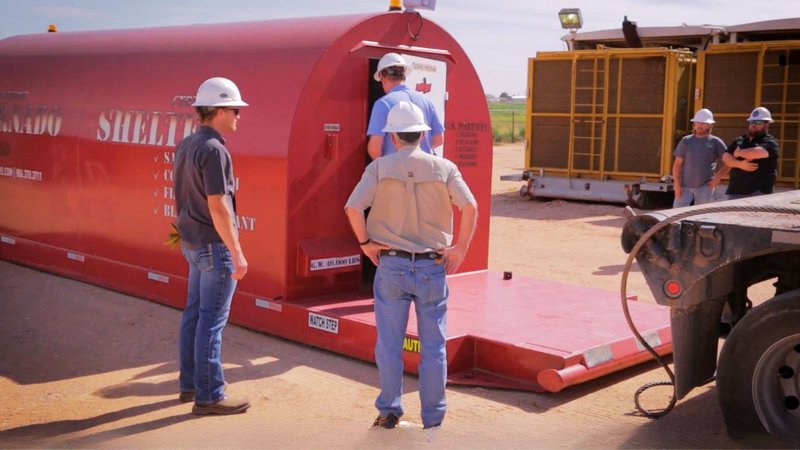
Moreover, units scale with the project. As headcount grows, additional shelter units join the fleet. As the project winds down, the fleet reduces. Customers reposition units themselves as zones shift, or Red Dog dispatches a winch truck to active construction sites. Because crews skip mechanical anchoring entirely, repositioning takes minutes without disrupting communications infrastructure already installed in the unit.
Deployment, Setup, and Operational Readiness
A custom storm shelter configured as a command hub needs to be operational before a severe weather event. Red Dog delivers units within 24 to 48 hours from yard locations in Moore, OK, Minden, LA, and Lubbock, TX. Trained drivers handle loading and unloading using a winch truck, so receiving crews need no additional equipment.
Once placed on flat ground, the patented Aerodynamic Anchoring system secures the unit immediately. By contrast, shelters requiring mechanical anchoring add setup time before crews can call the unit safe. A trained Red Dog crew reaches operational readiness in as little as five minutes. Therefore, site teams have time to install communications equipment, configure the command station, and brief supervisors before storm season begins.
In practice, the value of a custom storm shelter as a command hub goes beyond the worst ten minutes of a storm. It lies in what it enables the incident commander to do throughout the entire event.
Red Dog shelters are FEMA-rated, individually certified, and ready to support full command hub configurations. If your current shelter plan does not include a dedicated command function, reach out to learn more or place an order.