
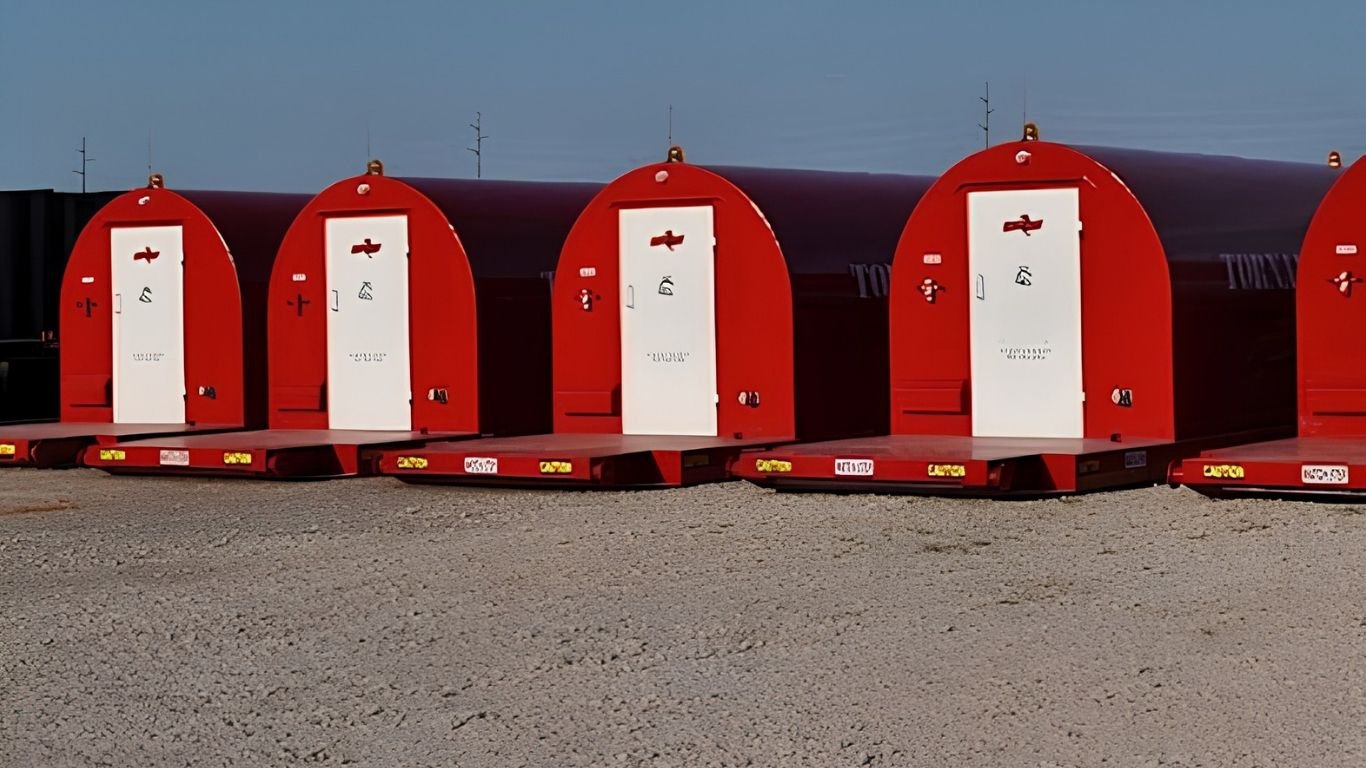
A job trailer sits at the edge of an oil field in West Texas. It has no FEMA certification, no rated capacity, and no independent testing. For the 20-person crew working nearby, it is still the only shelter in sight. For any facility without certified commercial storm shelters, that scenario is not hypothetical. It is a daily operational reality across oil and gas, construction, and energy sites throughout the country.
Yet many facilities still protect their crews with structures that carry no FEMA certification and no rated capacity. As a result, the difference between what a shelter looks like and what it can actually do remains dangerously wide.
What Separates a Certified Commercial Storm Shelter From a Standard Enclosure
Certified commercial storm shelters must pass independent engineering review and impact testing. FEMA P-361 sets the federal benchmark. To meet it, a structure must survive EF-5 wind loads. In addition, it must withstand a debris strike from a 15-pound 2×4 at 100 mph. Furthermore, that test covers the walls, door, and ventilation system. Ultimately, it is a physical threshold, not a paperwork standard.
Most standard enclosures on industrial sites carry no such rating. They may look solid. However, they have never faced the testing that FEMA P-361 requires. In short, the appearance of protection is not the same as a documented one. For safety directors filing compliance documentation with insurers or regulatory bodies, that distinction matters more than it might seem.
Why Industrial Sites Face a Different Exposure Profile
According to the National Weather Service Storm Prediction Center, the U.S. recorded 1,559 tornadoes in 2025, with 67 fatalities. Texas, Oklahoma, and Missouri ranked among the hardest-hit states. All three are active markets for oil and gas, pipeline, and construction work. For that reason, facilities in these regions carry a higher baseline exposure than most permanent structures.
Residential shelters protect a fixed number of people in a fixed location. Industrial sites do not work that way. Crew sizes shift. Also, work zones move as projects progress. In contrast, oil field operations, pipeline corridors, or large construction sites spread dozens of workers across several acres at once. That exposure profile needs a shelter solution built to match it.
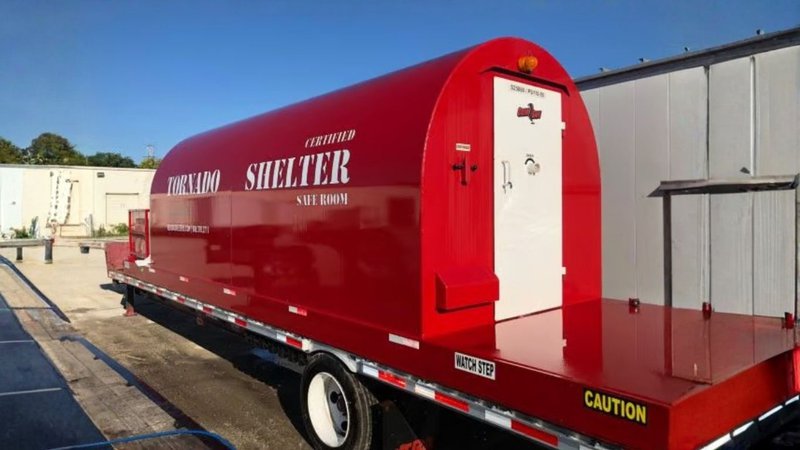
For instance, a single fixed structure at the site entrance does not cover a crew working half a mile away. Similarly, a unit certified for six to eight occupants does not serve a 30-person crew coming off a shift together. That is why distributed, scalable deployment matters on large industrial footprints.
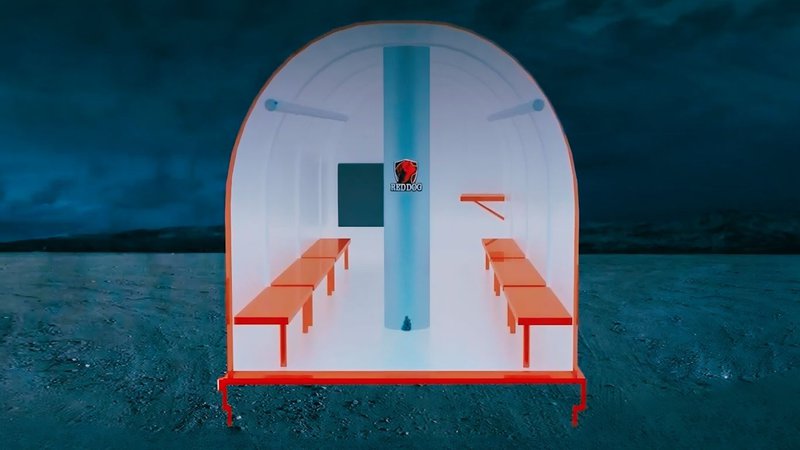
Red Dog Big Dog units hold 32 people per FEMA standards and measure 35 feet by 8.25 feet. Red Dog engineers stamp and certify each unit individually to meet and exceed FEMA P-361, FEMA P-320, ICC 500-2008, NSSA standards, and OSHA requirements. Because they need no foundation and no mechanical anchoring, teams spread multiple units across the full job site footprint. Units scale up as headcount grows. Similarly, they scale back as the job winds down. That means the fleet stays matched to actual site conditions at every phase.
The Daily Value of a Certified Shelter Beyond Storm Season
Commercial storm shelters do not have to sit idle between warnings. For that reason, Red Dog builds each unit for daily use across multiple functions. On a summer job site, units serve as cool-down stations for crews managing heat stress. In winter, they function as warming rooms. They also work as on-site meeting spaces, training rooms, and muster points.
Moreover, each unit acts as a Faraday cage when grounded. That protects crew members from high-voltage electrical charges during lightning events. For facilities running electrical work near substations, that adds a layer of protection well beyond tornado season.
By contrast, standard enclosures offer none of this. A job trailer provides shade. It does not provide FEMA-rated protection, blast resistance, or documented compliance for insurance purposes.
Deployment Without Foundation Work or Anchoring
One reason facilities delay is the assumption that installation needs significant site preparation. In practice, Red Dog shelters need none. There is no foundation to pour and no anchoring hardware to install. A trained Red Dog crew drops a unit onto flat ground, and it is ready. That process takes as little as five minutes.
The patented Aerodynamic Anchoring system makes this possible. The curved roof creates a low-pressure zone at the unit base under high wind loads. Together, two vacuum tubes transfer that pressure downward. As a result, the shelter locks to the ground without bolts or stakes. The harder the wind, the tighter the hold.
Red Dog runs yards in Lubbock, TX, and Moore, OK, for fast regional delivery. Units reach an active job site within 24 to 48 hours. Even so, customers can reposition units themselves as zones shift, or call Red Dog to send a winch truck.
Matching Your Commercial Storm Shelter Fleet to Your Site Risk Profile
Safety directors selecting a shelter for an industrial site should ask three questions. First, does the unit carry an individual FEMA P-361 certification? Second, can the fleet scale to match peak headcount across the full site footprint? Third, can units move as work zones shift without new anchoring or permits?
Red Dog answers all three. Therefore, the lease model means facilities avoid a large capital outlay. They right-size their fleet for each project phase instead. Furthermore, for operations managers across manufacturing facilities and energy sectors, balancing safety compliance with budget discipline, that combination is practical, not aspirational.
In short, the right commercial storm shelters do not just meet a minimum standard. They scale, relocate, and deliver daily value across every phase of an industrial project. That is why leading safety directors across oil and gas, construction, and manufacturing treat shelter deployment as a first-order planning input, not an afterthought.
Red Dog shelters are FEMA-rated, blast-tested, and ready to deploy. If your current setup cannot say the same, contact us to learn more or order.