

Severe weather can turn a productive jobsite into a dangerous place within minutes, and your crew depends on your planning. Choosing the right tornado shelter gives every worker a certified place to go when the sirens start. However, managers often face confusing capacity claims, installation demands, and logistics questions before they can make a confident decision.
You need a shelter that protects people, fits the site layout, and adapts as the project changes. Your selection also affects schedules, budgets, and the trust your crew places in your safety program. Use the criteria below to compare options and choose protection that matches the way your jobsite operates.
Start Your Tornado Shelter Search With Certified Standards
Every option on your shortlist should meet recognized engineering standards before you review features or logistics. Look for compliance with Federal Emergency Management Agency (FEMA) P-361 and International Code Council (ICC) 500 criteria for storm shelters. Additionally, ask whether a third party such as the National Storm Shelter Association (NSSA) verifies the design.
Red Dog units resist 250-mph winds and stop a 15-pound timber stud traveling at 100 mph. As a result, your crew gets near-absolute protection from the wind and flying debris that make tornadoes so deadly.
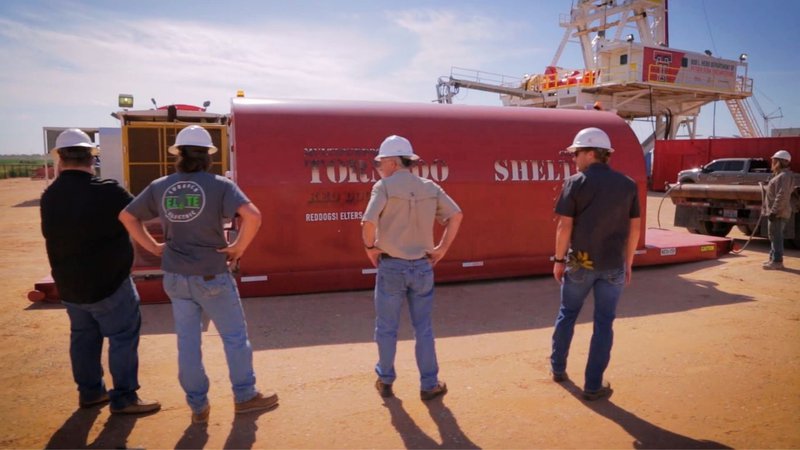
Next, verify how each vendor calculates occupancy, because the math directly affects how many workers you can protect. FEMA sets 5 square feet per occupant for a commercial tornado shelter, while residential guidance allows only 3 square feet. Red Dog divides its 160-square-foot cabin by 5 and rates each unit for 32 occupants.
Some vendors advertise larger numbers by applying the residential standard to commercial units of similar size. Consequently, a higher number on a spec sheet can leave your crew with less space than the standard requires. Ask every supplier to show the square footage and the divisor behind its stated capacity.
What Should a Manager Look for in a Jobsite Tornado Shelter?
Choose a tornado shelter that meets FEMA commercial standards and rates capacity at 5 square feet per person. The unit should also deploy without foundation work, relocate as the site changes, and scale with your headcount. Finally, confirm built-in alerts, lighting, and climate control so workers can shelter safely for extended periods.
Match Deployment and Mobility to Your Project
A jobsite changes every month, so your shelter plan must keep pace with grading, framing, and demobilization. Traditional underground shelters lock you into one location and require excavation, concrete, and inspection time. In contrast, a mobile tornado shelter arrives ready to protect your crew without any foundation work.
- No anchoring delays: Red Dog units sit on flat ground and protect your crew in as little as five minutes.
- Scalable fleet: You add units as headcount grows and reduce them as the job winds down.
- Distributed placement: Compact units spread across the site so workers reach shelter fast when storms develop quickly.
- Flexible relocation: Your team moves units with its own equipment, or Red Dog sends a winch truck.

Together, these advantages keep protection close to active work zones instead of parked at a distant corner. Furthermore, you avoid the sunk cost of a permanent structure left behind when the project ends. Read more about portable storm shelters without concrete foundations before you finalize a site plan.
Faster deployment also supports your schedule because crews lose less time walking to distant shelters. Meanwhile, distributed units shorten the time between a warning and a closed door.
Evaluate Comfort, Alerts, and Multi-Purpose Value
Storms rarely pass in minutes, so occupants may stay inside long after the first warning clears. Red Dog units include dual air conditioners, heaters, and a Rapid Cool Down station for summer heat. Additionally, a 128-decibel siren and strobe lights alert workers across noisy sites before the storm arrives.
Your tornado shelter can serve the site every day instead of sitting idle between storms. For example, crews use units as cooling rooms, muster points, and multi-purpose job site spaces throughout the week. The steel shell also acts as a Faraday cage, so workers gain protection during lightning storms.
Proper ventilation matters as much as cooling when 32 people share a sealed space for an extended period. Review Occupational Safety and Health Administration (OSHA) ventilation guidance to confirm healthy airflow for every occupant.
Lastly, consider who will manage maintenance, inspections, and repositioning over the life of the project. A leasing partner handles those tasks and lets your team focus on production and safety. Pricing varies with lease length, so a short conversation gives you an accurate picture for your timeline.
Secure the Right Tornado Shelter for Your Crew Today
The right selection protects your people, supports your schedule, and stands up to audit scrutiny. Therefore, prioritize certified standards, honest capacity ratings, and mobility that matches the way your project evolves. Red Dog Shelters delivers all three with patented aerodynamic anchoring and units that deploy in 24 to 48 hours.
Every project timeline differs, so lease terms depend on how long you keep each unit on site. Our team will walk you through options, placement strategy, and scaling as your headcount changes. Contact us today to plan the shelter strategy your jobsite needs before the next storm arrives.